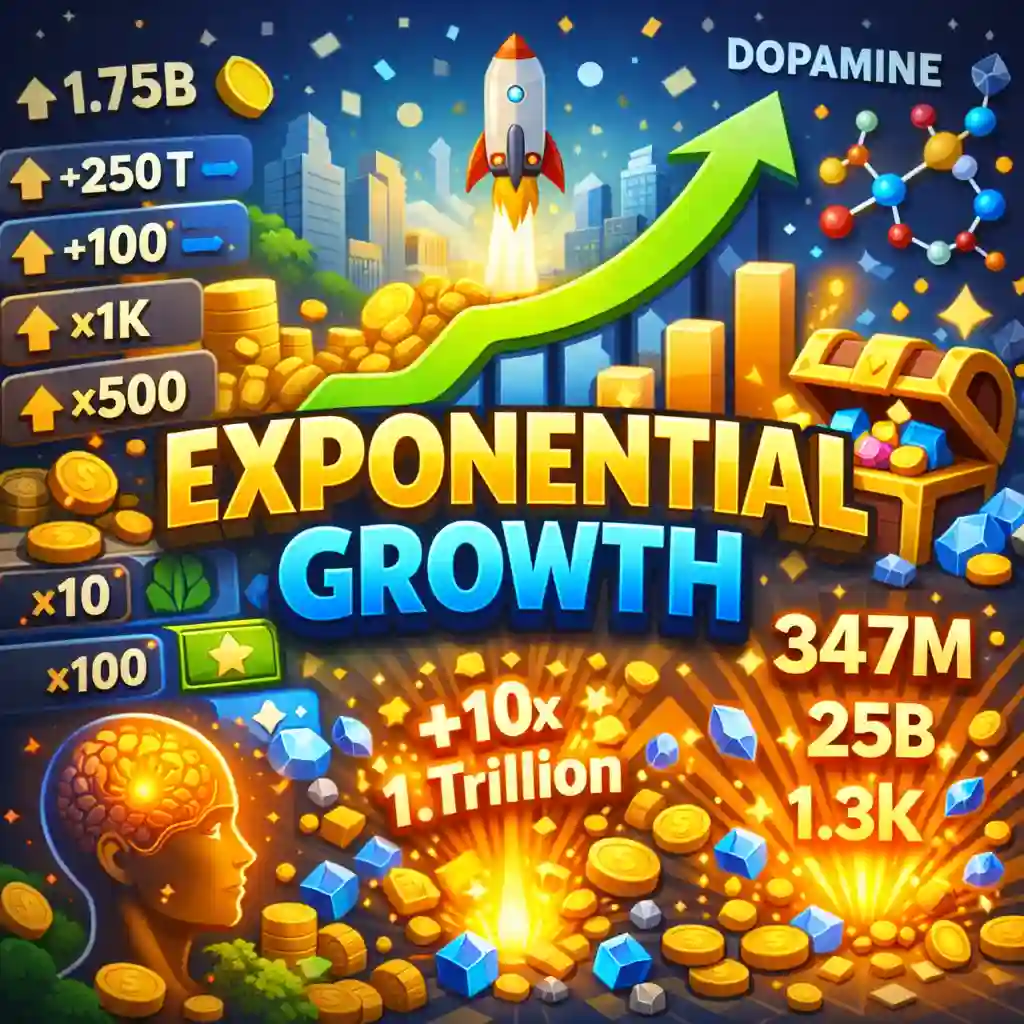
Why Exponential Growth Feels So Satisfying
Discover why exponential growth feels so satisfying in incremental and idle games. Learn how dopamine loops, perceived acceleration, and compounding multipliers drive player motivation and long-term retention.
Exponential growth feels satisfying because it creates accelerating progress, visible momentum, and powerful psychological reinforcement. In incremental and idle games, each upgrade compounds previous gains, producing rapid numerical expansion that triggers dopamine-driven reward loops and long-term engagement.
The Psychology Behind Rising Numbers
Human brains are wired to respond to progress. When we see visible improvement especially measurable improvement it activates reward systems associated with motivation and pleasure.
Exponential growth amplifies this effect.
In a linear system, gains feel steady but predictable. In an exponential system, gains feel explosive. Each upgrade increases output faster than the previous one. The result is a sense of acceleration. Players do not just progress they feel like they are taking off.
This acceleration creates emotional momentum. Instead of thinking, “I gained 10 more,” the player thinks, “I am scaling faster than ever.”
That perception is powerful.
The Dopamine Loop in Incremental Design
Dopamine is not triggered by rewards alone. It is triggered by anticipated rewards.
Exponential systems create short, repeatable anticipation cycles:
Because upgrades compound, each purchase meaningfully changes the pace of growth. The player sees immediate feedback. This instant reinforcement strengthens the behavior loop.
The more layers of scaling that exist multipliers, prestige bonuses, skill trees, the more opportunities the game has to deliver satisfying spikes of progress.
Over time, this loop builds habit formation. Players log in not just to gain resources, but to experience acceleration.
Perceived Acceleration vs Actual Growth
Here is where design theory becomes interesting.
Exponential growth is not just mathematically powerful, it feels powerful.
When numbers double repeatedly, players perceive acceleration even if the underlying formula is controlled. Designers can manipulate:
Even small exponential curves can feel massive when presented visually with large numbers and dramatic UI feedback.
This is why number presentation matters. Jumping from 1,000 to 10,000 feels impactful. Jumping from 10,000 to 11,000 feels minor. The structure of exponential curves ensures that the jumps feel increasingly dramatic over time.
The Number Explosion Effect
One of the most satisfying moments in an incremental game is the “number explosion”, when production jumps from millions to billions or from billions to quintillions in a short span.
That explosion happens because of compounding multipliers.
For example:
Stacked multiplicatively, these systems amplify output dramatically.
When all these layers trigger at once, the result is an explosive spike in visible power. The player feels unstoppable.
This moment is carefully engineered. Designers often create “breakthrough points” where multiple upgrades unlock simultaneously to produce dramatic acceleration.
The goal is not chaos. The goal is controlled euphoria.
Why Exponential Systems Improve Retention
Retention design is about keeping players engaged over long periods.
Exponential growth supports retention in three major ways:
First, it creates hope during slow phases. Even if progress temporarily stalls, players know a breakthrough upgrade exists ahead.
Second, it rewards optimization. Players experiment with builds, multipliers, and timing to maximize compounding effects.
Third, it supports reset mechanics. When a game includes prestige systems, exponential scaling ensures that each new run starts stronger than the last.
This structure transforms repetition into empowerment.
If you want to understand how exponential systems integrate into broader RPG frameworks with combat, gear, and layered progression loops, the foundation is explained in What Is an Idle RPG? Complete Beginner Explanation, which shows how scaling becomes the backbone of modern idle RPG design.
The Balance Between Satisfaction and Saturation
Exponential growth must be carefully balanced.
If numbers grow too slowly, players feel stuck.If numbers grow too quickly, progress feels meaningless.
Good incremental design includes:
These mechanics create rhythm. The player alternates between effort and reward, buildup and explosion.
Without that rhythm, exponential systems lose their emotional impact.
The Illusion of Infinite Growth
Another reason exponential systems feel satisfying is the illusion of infinity.
As numbers climb into absurd magnitudes, sextillions, octillions, beyond, players experience a sense of limitless potential. The scale becomes abstract, but the momentum remains tangible.
This illusion keeps curiosity alive. “How high can I go?” becomes the driving question.
Incremental games rarely aim for true infinity. Instead, they create layered ceilings that reset into higher tiers of scaling.
The feeling of endless growth, even if technically bounded, sustains engagement far longer than fixed-level systems.
Why Designers Love Exponential Curves
From a design perspective, exponential systems are efficient.
They allow:
Instead of constantly creating new handcrafted levels, designers create growth engines. Those engines generate engagement through compounding interactions.
It is not complexity that drives satisfaction. It is scaling.
Conclusion
Exponential growth feels satisfying because it delivers acceleration, visible progress, and compounding reinforcement. It transforms small actions into dramatic results and turns repetition into momentum.
Through dopamine-driven feedback loops, perceived acceleration, and carefully engineered number explosions, exponential systems create some of the most powerful engagement mechanics in modern game design.
When structured correctly, exponential growth does not just increase numbers. It increases motivation, retention, and emotional investment, making it one of the most effective progression models in incremental and idle game design.