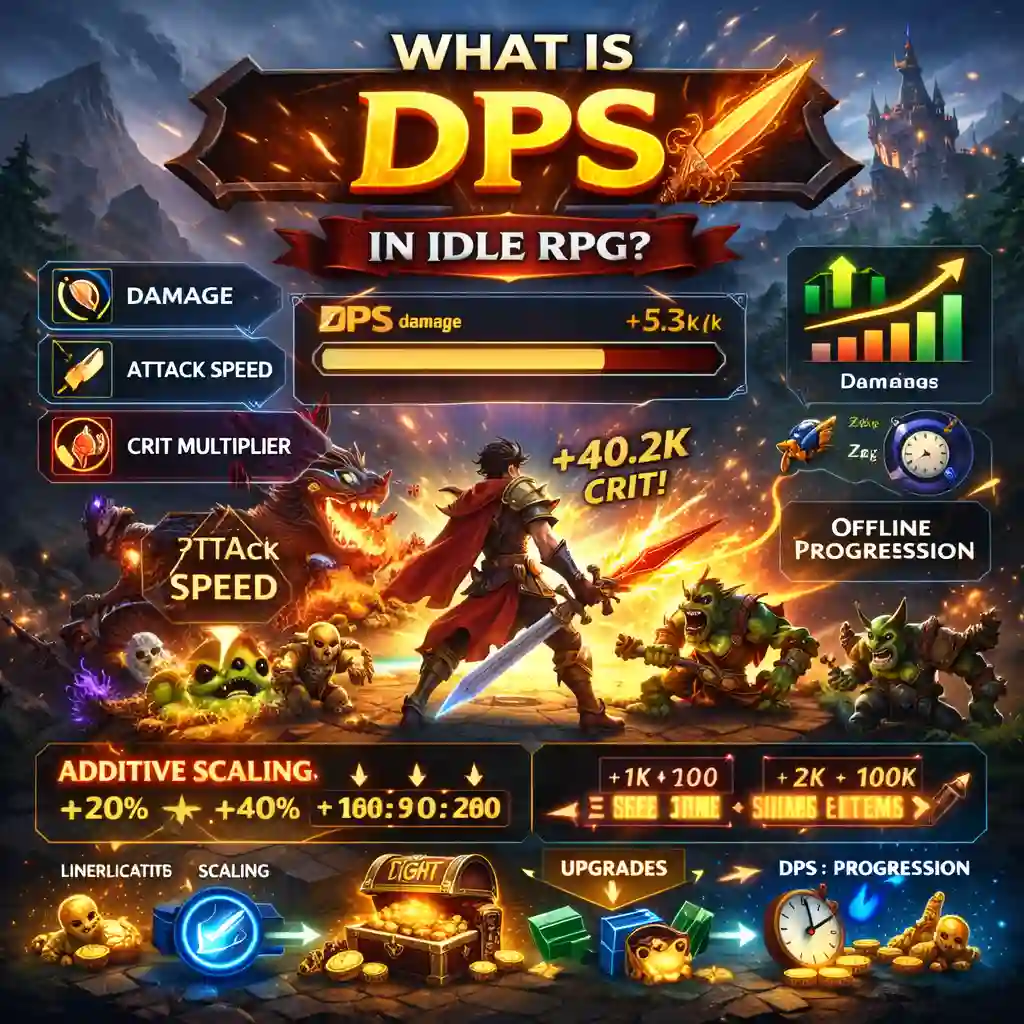
What Is DPS in Idle RPG? (Complete Beginner Guide)
What is DPS in idle RPG? Learn how Damage Per Second works, how it’s calculated, and why DPS scaling, multipliers, and exponential growth drive progression in idle RPG systems.
DPS (Damage Per Second) in idle RPGs measures how much damage your character deals every second and acts as the primary indicator of progression speed. In most idle RPGs, increasing DPS determines how fast you defeat enemies, clear stages, earn rewards, and scale into higher content tiers. Understanding DPS is essential for optimizing growth, multipliers, and long-term progression systems.
What Does DPS Mean in Idle RPGs?
DPS stands for Damage Per Second. It represents the total average damage your character deals in one second of combat.
Unlike traditional RPGs where skill timing and mechanics matter heavily, idle RPGs revolve around statistical efficiency. The higher your DPS:
-
The faster enemies die
-
The quicker you clear stages
-
The more resources you earn
-
The smoother your scaling becomes
In idle systems, DPS is not just a combat stat. It is the engine of progression.
Why DPS Is the Most Important Metric in Idle RPGs
Idle RPG progression is tied directly to clear speed. If enemies die faster, the core loop accelerates:
Kill → Reward → Upgrade → Higher DPS → Faster Kill
Everything funnels back into increasing damage output. Even systems like gold farming, prestige efficiency, and offline gains depend on your DPS baseline.
If your DPS stalls, your entire progression loop slows down.
How DPS Is Calculated
Most idle RPGs calculate DPS using a simplified structure like:
DPS = Damage per Hit × Attacks per Second
However, real formulas are usually layered with multipliers.
A more complete structure may look like:
DPS = Base Attack × Multipliers × Critical Modifier × Attack Speed
Let’s break that down.
Base Attack
This is your raw damage stat before bonuses. It increases through:
-
Leveling up
-
Equipment upgrades
-
Skill improvements
-
Training systems
Base attack forms the foundation of all scaling.
Attack Speed
Attack speed determines how many times your character hits per second.
For example:
If damage per hit is 1,000 and you attack twice per second, your DPS is 2,000.
Increasing attack speed multiplies total output over time.
Critical Chance and Critical Damage
Critical systems introduce probability-based scaling.
Example:
-
25% Crit Chance
-
200% Crit Damage
On average, this increases your total DPS over time rather than in a single burst.
In idle RPGs, crit systems function as passive multipliers integrated into long-term averages.
Additive vs Multiplicative Scaling
Not all bonuses increase DPS the same way.
Additive Bonuses
Additive bonuses stack together before being applied.
Example:
+20% damage
+30% damage
Total = +50%
Multiplicative Bonuses
Multipliers stack on top of each other.
Example:
Base × 1.20 × 1.30 = 1.56 (56% increase, not 50%)
Multiplicative scaling becomes extremely powerful in late-game idle RPGs.
Understanding this difference is crucial for optimization.
Linear vs Exponential DPS Growth
Early in the game, DPS increases feel steady and predictable.
+100
+200
+300
This is linear growth.
Later, idle RPGs transition into exponential growth:
1K
10K
100K
1M
1B
Exponential scaling is necessary because enemy HP also scales exponentially. Without accelerating DPS curves, progression would eventually stall.
How DPS Affects Offline Progression
Idle RPGs often simulate combat while you are offline.
Offline rewards depend heavily on:
-
Average DPS
-
Stage cleared
-
Survival capability
Higher DPS means:
-
Faster simulated kills
-
More gold accumulated
-
Greater resource efficiency
DPS directly influences how productive your idle time becomes.
DPS as a Progression Gate
Many idle RPGs use DPS as a hidden requirement system.
If your DPS is too low:
-
You cannot defeat bosses
-
You fail damage checks
-
You cannot advance to new stages
Bosses often act as DPS filters. If you cannot defeat them within a time limit, you must return to upgrading.
This reinforces DPS as the central progression checkpoint.
Common Beginner Mistakes with DPS
Focusing Only on Base Damage
New players often stack raw attack while ignoring multipliers or synergy systems.
Multipliers frequently provide greater long-term returns.
Ignoring Attack Speed
Doubling attack speed can be equivalent to doubling damage in many systems.
Misunderstanding Upgrade Order
Upgrading low-impact stats early can slow long-term scaling efficiency.
Smart sequencing matters.
DPS and Long-Term Scaling Strategy
Optimizing DPS involves more than just buying upgrades.
It requires:
-
Identifying multiplicative boosts
-
Timing prestige resets
-
Balancing survivability with damage
-
Investing in exponential systems
As progression advances, DPS optimization becomes a strategic puzzle rather than a simple stat increase.
How DPS Connects to the Core of Idle RPG Design
DPS is not just a combat number. It is the backbone of idle RPG mechanics.
Without DPS scaling:
-
Automatic combat would stall
-
Upgrade systems would feel meaningless
-
Prestige loops would lack impact
If you want to understand how DPS fits into the broader structure of automation, scaling, and progression loops, read our complete guide: What Is an Idle RPG? Complete Beginner Explanation. That main article explains how DPS interacts with automatic combat systems, multipliers, and long-term growth design.
Conclusion
DPS in idle RPGs measures more than damage per second. It measures progression speed, efficiency, and long-term growth potential.
By understanding how DPS is calculated, how multipliers stack, and how exponential scaling works, players can optimize their builds and avoid common progression traps.
In idle RPGs, increasing DPS is not optional. It is the core objective that drives every system forward.