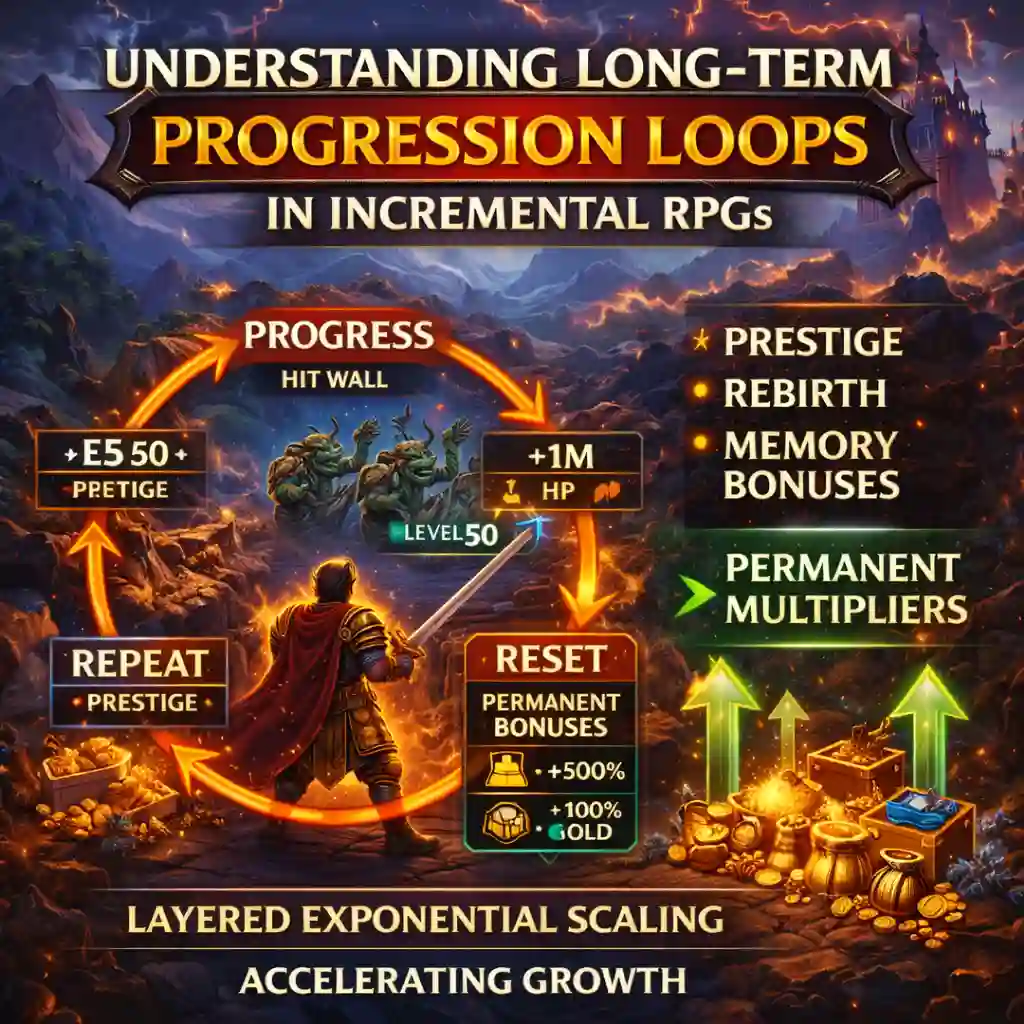
Understanding Long-Term Progression Loops in Incremental RPGs
Understand long-term progression loops in incremental RPGs, including prestige systems, reset timing, permanent multipliers, and how layered exponential scaling drives sustained growth and engagement.
Long-term progression loops in incremental RPGs are systems that allow players to reset short-term progress in exchange for permanent bonuses that accelerate future growth. These loops create layered exponential scaling, sustained engagement, and strategic depth. Understanding how progression cycles, prestige timing, and permanent multipliers interact is essential for optimizing long-term efficiency in idle and incremental RPG design.
What Is a Long-Term Progression Loop?
A long-term progression loop is a recurring cycle where players:
This structure transforms what would normally feel like a setback into forward momentum.
Instead of permanent grinding in one continuous line, incremental RPGs use cyclical growth to create compounding power over time.
The Core Structure of Incremental Progression
Most incremental RPGs operate on two layers of progression:
Short-Term Loop
This loop drives immediate satisfaction.
Long-Term Loop
The long-term loop ensures scaling never truly stagnates.
Why Resetting Progress Feels Rewarding
At first glance, resetting progress sounds counterintuitive. However, incremental RPGs design resets to be empowering.
When players reset:
The next run becomes faster and more efficient.
This creates a psychological shift: resets are not losses, but investments.
Exponential Scaling Through Layered Loops
Long-term progression relies heavily on exponential growth.
Consider this simplified structure:
Run DPS Growth × Permanent Prestige Multiplier × System Multipliers
Each layer compounds the others.
As loops stack:
Without layered progression loops, exponential systems would plateau.
Prestige Timing and Optimization
Reset timing dramatically affects efficiency.
Reset Too Early
You gain smaller permanent bonuses and may waste potential growth.
Reset Too Late
Upgrade costs may become inefficient, slowing overall progression.
Efficient players look for the point where:
Time spent pushing further yields less value than resetting.
Finding this equilibrium maximizes long-term scaling speed.
Types of Long-Term Progression Systems
Incremental RPGs implement loops in different forms.
Prestige Systems
Reset progress for permanent global multipliers.
Rebirth Mechanics
Often reset deeper systems but unlock new mechanics.
Memory or Meta Layers
Provide persistent bonuses that carry across all runs.
Ascension or Tiered Resets
Introduce multiple layers of resets, each stronger than the last.
Each additional layer deepens the exponential structure.
The Role of Multipliers in Long-Term Loops
Multipliers are the fuel behind progression cycles.
Permanent bonuses usually stack multiplicatively with run-based upgrades.
For example:
Base Damage × Run Multiplier × Prestige Multiplier × Global System Multiplier
Every reset increases the baseline for future runs.
This is how incremental RPGs maintain long-term engagement without constant manual input.
Progression Walls and Scaling Breakpoints
Long-term loops naturally create walls.
Walls occur when:
Walls are intentional design elements.
They signal that the optimal strategy may be to reset and amplify scaling rather than continue pushing inefficiently.
Why Long-Term Loops Sustain Engagement
Without progression loops, idle RPGs would eventually become repetitive.
Long-term systems introduce:
Players experience measurable growth not only within a run, but across runs.
That layered advancement is what keeps incremental RPGs engaging for months or even years.
Common Misunderstandings About Progression Loops
Some players assume:
“Prestige is just forced repetition.”
In reality, well-designed loops create acceleration.
Each reset should meaningfully shorten the path to previous milestones.
If progression feels identical after resetting, the loop lacks sufficient multiplier layering.
Strong incremental design ensures each cycle feels more powerful than the last.
How Long-Term Progression Connects to Idle RPG Design
Long-term progression loops are one of the structural pillars of idle RPG systems.
Automatic combat provides consistent resource flow.DPS scaling enables exponential growth.Multipliers create compounding acceleration.Prestige systems convert short-term effort into permanent power.
If you want to see how long-term loops integrate with automation, DPS mechanics, and multiplier stacking, read our complete guide: What Is an Idle RPG? Complete Beginner Explanation. That pillar article explains how all core systems connect into one cohesive progression framework.
Conclusion
Long-term progression loops transform incremental RPGs from simple number growth into layered strategic systems.
By resetting progress strategically, stacking permanent multipliers, and optimizing timing, players unlock exponential scaling that sustains long-term engagement.
In incremental RPGs, progress is not a straight line. It is a cycle that becomes stronger with every loop.