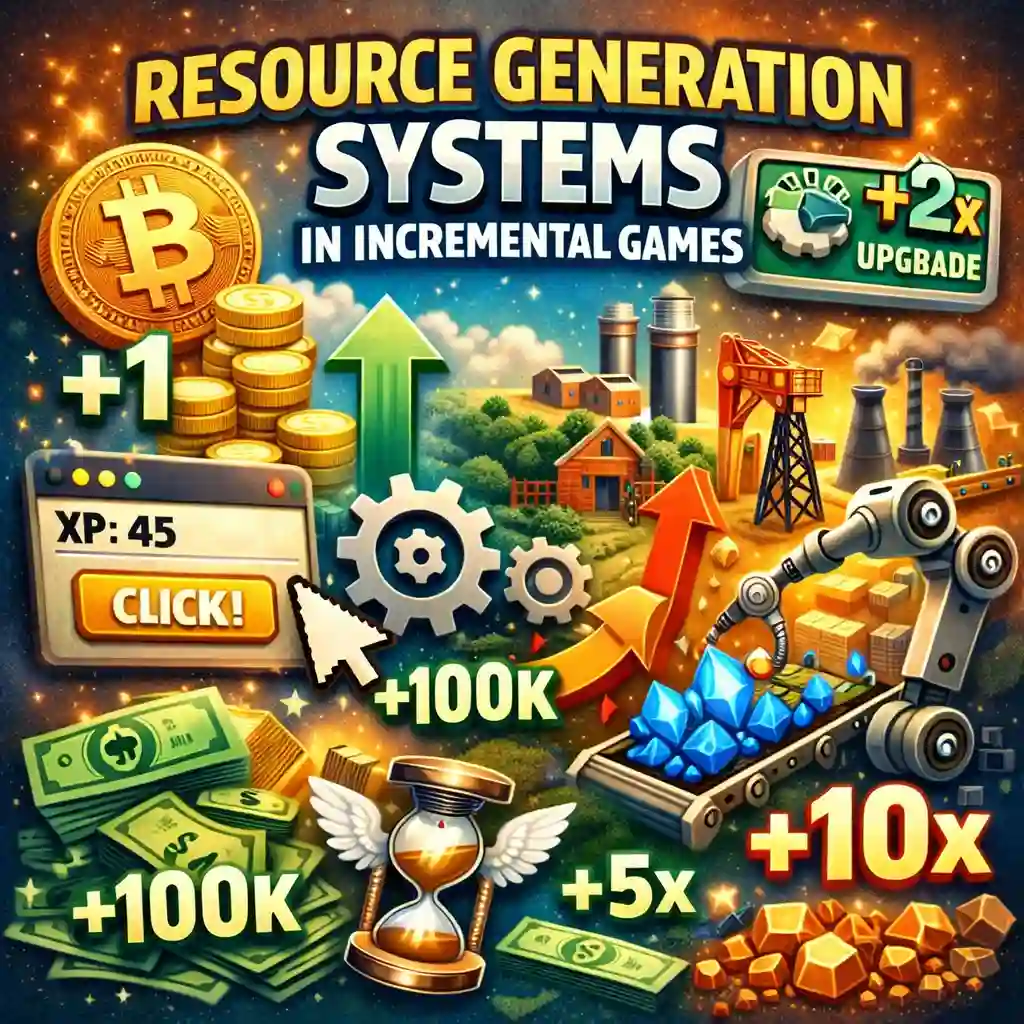
Resource Generation Systems in Incremental Games
Learn how resource generation systems power incremental games, from manual clicking and passive income to automated production chains, multipliers, and scalable progression mechanics.
Resource generation systems are the backbone of incremental games. These systems determine how players produce currency, accumulate resources, and progress through the game over time. From simple manual clicking to complex automated production chains, resource generation mechanics drive the entire gameplay loop and create the satisfying progression that defines the incremental genre.
What Is Resource Generation in Incremental Games?
Resource generation refers to the mechanics that allow players to produce in-game currency, materials, or points over time. These resources are then used to purchase upgrades, unlock new systems, or increase production rates.
In most incremental games, resource generation follows a loop where players produce resources, invest them into upgrades, and increase production efficiency. This loop repeats continuously, allowing numbers to grow larger and progression to accelerate.
Because incremental games are built around long-term progression, resource generation systems must be carefully balanced to keep players engaged for extended periods of time.
The Core Resource Loop
At the center of most incremental games is a simple but powerful gameplay loop. Players generate resources, spend those resources on upgrades, and then generate resources even faster.
The loop typically follows this structure:
This feedback loop is what creates the addictive progression experience often associated with incremental games. Each upgrade pushes production higher, which in turn unlocks more powerful upgrades.
Over time, the numbers produced by the system can grow exponentially, making the progression feel dramatic and rewarding.
Manual Resource Generation
Many incremental games start with manual resource generation. In this stage, players actively click or perform actions to produce resources.
Examples include:
Manual generation introduces players to the game’s core mechanics and allows them to experience immediate feedback. Each click produces a visible result, reinforcing the sense of progress.
However, manual generation usually becomes less important as players unlock automation systems later in the game.
Passive Resource Generation
Passive resource generation is one of the defining features of incremental games. Instead of requiring constant interaction, the game produces resources automatically over time.
Passive systems can include:
These systems allow players to progress even when they are not actively interacting with the game. This is one reason incremental games are often associated with idle gameplay.
Passive generation also allows developers to create more complex economic systems, where multiple production sources contribute to overall resource output.
Automated Production Systems
Automation is what transforms simple clicker mechanics into deeper incremental gameplay.
Automated systems typically include resource generators such as:
As players unlock these systems, the focus shifts from manual clicking to strategic management. Players must decide which generators to upgrade and how to optimize production efficiency.
Automation also introduces scaling opportunities, allowing the resource output to grow significantly over time.
Production Chains and Resource Layers
Many advanced incremental games use production chains where one resource is required to produce another.
For example:
These chains create layered economies where different resources interact with each other. Players must balance multiple systems simultaneously to maximize efficiency.
Production chains also help extend gameplay progression by introducing new resource tiers as the game advances.
Multipliers and Production Boosts
Multipliers are a critical component of resource generation systems. Instead of increasing production linearly, multipliers allow resource output to scale dramatically.
Common multiplier systems include:
These multipliers create exponential growth, which is essential for maintaining long-term progression in incremental games.
Without scaling systems like multipliers, resource generation would eventually slow down and progression would stagnate.
Offline Resource Generation
Many modern incremental games include offline generation systems. These mechanics allow players to accumulate resources even when they are not actively playing.
When players return to the game, they often receive a summary of resources generated while offline.
Offline generation systems are especially common in mobile incremental games because they encourage players to return periodically without requiring constant attention.
This feature helps maintain engagement while allowing the game to progress passively in the background.
Balancing Resource Generation Systems
Designing resource generation systems requires careful balancing. If production grows too slowly, players may lose interest. If it grows too quickly, the game may lose its sense of progression.
Developers often balance resource systems by adjusting:
The goal is to create a progression curve where players constantly feel rewarded while still facing new milestones and challenges.
Proper balancing ensures that players remain engaged throughout both the early and late stages of the game.
Resource Systems and the Core Design of Incremental Games
Resource generation is not just a mechanic it is the foundation of the incremental genre itself. Nearly every system in an incremental game revolves around producing, managing, and scaling resources.
Understanding how these systems work is essential for understanding the genre as a whole. If you want a deeper explanation of the core concepts behind incremental gameplay, the guide What Is an Incremental Game? Complete Guide to Incremental Games, Mechanics, and Progression Systems explores the mechanics, progression structures, and design principles that define incremental games.
Conclusion
Resource generation systems are the driving force behind incremental games. They determine how players progress, how upgrades function, and how gameplay evolves over time.
From manual clicking mechanics to complex automated production chains, these systems create the steady progression that makes incremental games so satisfying. By carefully balancing production, automation, and scaling systems, developers can build gameplay loops that remain engaging for hours or even months.
As incremental games continue to evolve, resource generation systems will remain the central mechanic that powers the genre’s unique and addictive progression design.