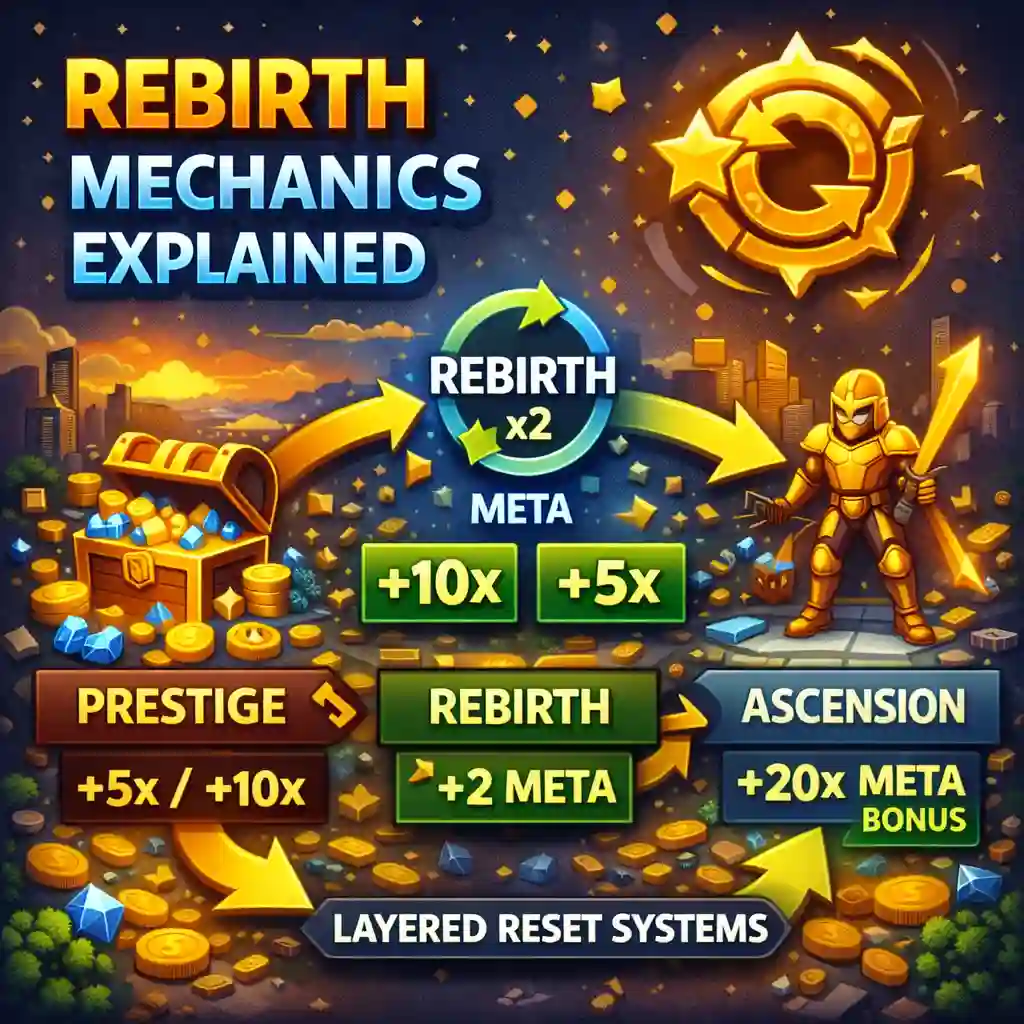
Rebirth Mechanics Explained
Learn how rebirth mechanics work in idle games, how they differ from prestige systems, and how layered reset structures extend exponential scaling and long-term progression.
Rebirth mechanics are advanced reset systems in idle and incremental games that go deeper than standard prestige. While prestige resets short-term progress for permanent multipliers, rebirth often resets multiple progression layers, unlocking stronger meta bonuses and extending long-term scaling potential.
What Is a Rebirth Mechanic?
A rebirth mechanic is a structured reset system that operates above traditional prestige. When players trigger rebirth, they typically reset more progress than a standard prestige would — sometimes including prestige currencies themselves.
In exchange, players receive stronger, long-term bonuses that dramatically increase future scaling.
If prestige improves a single run, rebirth improves the entire progression framework.
Rebirth systems are usually introduced in mid-to-late game stages, once standard prestige loops no longer provide meaningful acceleration.
Prestige vs Rebirth: What’s the Difference?
Although both are reset mechanics, their scope and impact differ.
Prestige:
Rebirth:
In simple terms, prestige strengthens the character.Rebirth strengthens the system that strengthens the character.
This distinction becomes critical in games designed for extremely long-term engagement.
When Do Games Introduce Rebirth?
Rebirth mechanics usually appear when:
Instead of endlessly inflating numbers within one loop, rebirth creates a new loop above it.
This layered approach prevents burnout and keeps growth meaningful.
Layered Reset Structures
Modern idle games often use multi-layer reset systems.
For example:
Base Progression → Prestige → Rebirth → Ascension → Transcendence
Each layer resets deeper portions of the game while granting exponentially stronger bonuses.
This structure allows:
Layered resets are not random. They are carefully paced to maintain rhythm between effort and acceleration.
If you want to understand how rebirth fits into the broader structure of idle RPG systems, including automation, DPS scaling, and prestige loops, the foundational framework is explained in What Is an Idle RPG? Complete Beginner Explanation, where scaling and reset mechanics form the backbone of long-term progression.
Multi-Layer Reset Example
To understand how rebirth differs from prestige, consider a simplified example:
Stage 1: Base ProgressionPlayers level up, gain equipment, and increase DPS.
Stage 2: PrestigePlayers reset levels but gain a permanent 5× multiplier.
Stage 3: RebirthPlayers reset prestige currency and receive a 2× global meta multiplier affecting all future prestige gains.
Stage 4: AscensionPlayers reset rebirth bonuses but unlock entirely new systems or mechanics.
Each layer compounds the previous one.
The deeper the reset, the stronger the long-term amplification.
This recursive amplification is what allows idle games to scale into extreme magnitudes without collapsing pacing.
Strategic Rebirth Timing
Like prestige, rebirth is often strategic.
Triggering rebirth too early may produce weak meta bonuses. Waiting too long may cause stagnation.
Optimal rebirth timing depends on:
High-level players often calculate when rebirth yields maximum long-term gain.
This strategic layer adds depth beyond simple number growth.
Psychological Impact of Rebirth Systems
Rebirth mechanics reshape how players view progress.
Instead of focusing on immediate stats, players think in meta cycles.
This shift creates:
The emotional effect mirrors prestige but on a larger scale.
Rebirth systems turn the entire game into a scalable engine.
Design Risks of Rebirth Mechanics
While powerful, rebirth systems must be balanced carefully.
Potential risks include:
Successful implementations introduce rebirth gradually and clearly communicate its long-term value.
Clarity is essential. If players do not understand why they are resetting, motivation declines.
Why Rebirth Extends Game Longevity
Without layered resets, exponential systems eventually plateau.
Rebirth adds a new dimension of growth. Instead of simply increasing numbers horizontally, the game expands vertically into new tiers of scaling.
This vertical expansion extends the lifespan of idle games dramatically.
Rather than designing endless new content manually, developers create recursive growth layers that amplify existing systems.
It is scalability by structure.
Conclusion
Rebirth mechanics are advanced reset systems that operate beyond traditional prestige. By resetting deeper progression layers in exchange for powerful meta bonuses, rebirth extends exponential scaling and refreshes long-term engagement.
While prestige strengthens individual runs, rebirth strengthens the entire progression framework.
When implemented correctly, layered reset systems transform idle games into long-term growth engines, continuously renewing momentum while pushing scaling potential higher with each cycle.