Progression and Scaling in Incremental Games
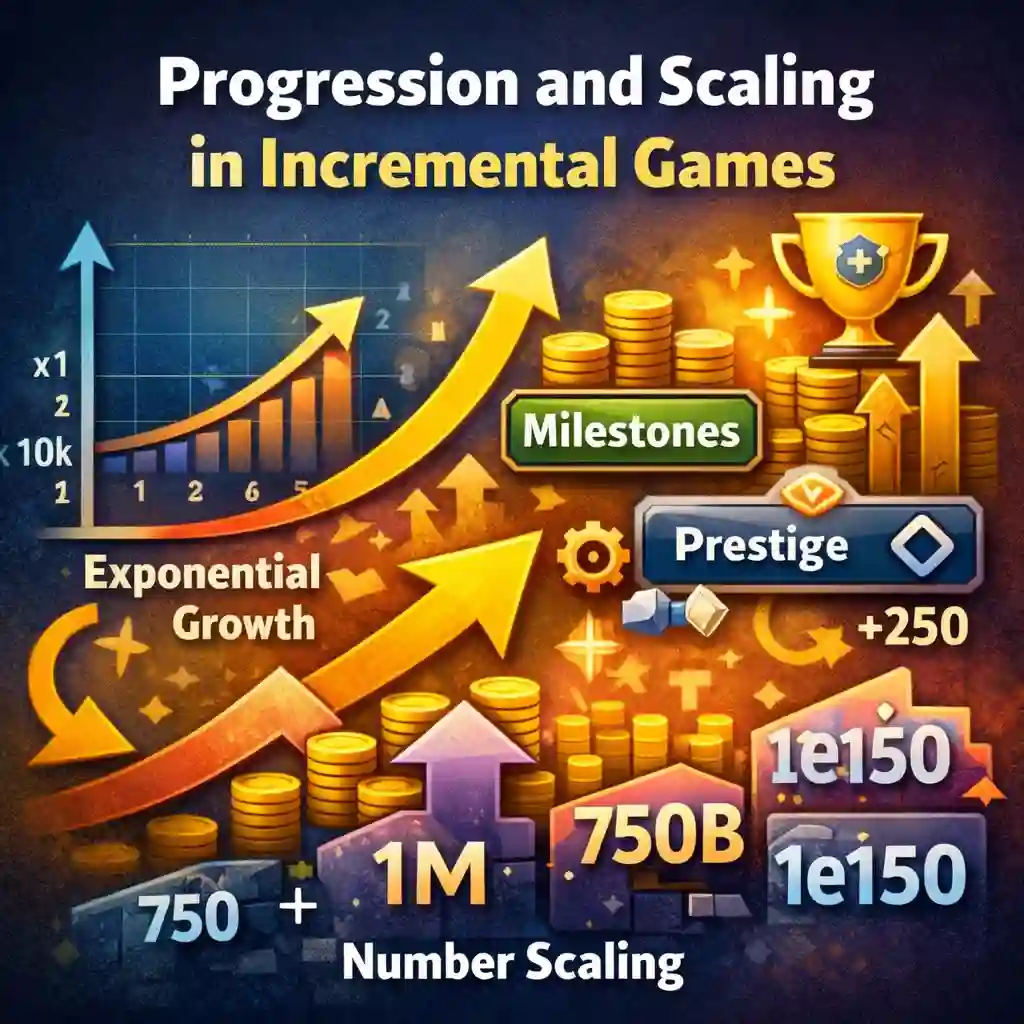
Progression and scaling in incremental games explain how numbers grow through exponential systems, milestones, and prestige resets to create long-term gameplay progression and balance.
Progression and scaling in incremental games refer to the systems that allow numbers, production rates, and milestones to grow continuously as players advance. These mechanics include scaling formulas, exponential growth patterns, prestige resets, and milestone unlocks that keep the game expanding while maintaining balance and long-term player engagement.
Understanding Progression in Incremental Games
Progression is the core driver that keeps players engaged in incremental games. Unlike traditional games that rely on levels, story progression, or combat systems, incremental games focus on the steady growth of numbers and production systems over time.
Players typically begin with a simple mechanic such as generating a small amount of currency or resources. As they continue playing, they unlock upgrades, new generators, and automation systems that significantly increase their production capabilities.
This gradual expansion creates a sense of continuous advancement. Every improvement pushes the player closer to new milestones, stronger upgrades, and larger production numbers.
To better understand how these systems fit into the broader genre, it helps to explore the overall structure of incremental game design. Our main guide, What Is an Incremental Game? Complete Guide to Incremental Games, Mechanics, and Progression Systems, explains how progression mechanics work alongside automation, upgrades, and resource generation to create the long-term gameplay loops that define incremental games.
Number Scaling Systems in Incremental Games
Scaling systems determine how numbers grow as the game progresses. Since incremental games are built around constantly increasing values, developers must carefully design scaling formulas that keep the game balanced.
In the early stages of an incremental game, numbers usually increase at a slow and manageable rate. Players might generate a few resources per second or unlock upgrades that slightly improve production efficiency.
However, as players advance, the scaling systems allow these numbers to increase dramatically. Instead of earning tens or hundreds of resources, players may begin producing thousands, millions, or even astronomical numbers.
There are several common scaling approaches used in incremental games:
• Linear scaling – numbers increase at a steady rate.• Multiplicative scaling – upgrades multiply resource output.• Exponential scaling – growth accelerates rapidly over time.• Soft caps and balancing systems – mechanics that slow progression to maintain long-term gameplay.
Scaling systems are essential because they ensure the game continues to evolve without becoming stagnant or impossible to progress.
Exponential Growth in Incremental Games
Exponential growth is one of the defining characteristics of incremental gameplay. Unlike linear progression, exponential systems allow numbers to increase at an accelerating rate.
For example, if a player’s production doubles with every major upgrade, their resource output grows much faster with each improvement. This creates a powerful sense of momentum, where previously difficult milestones suddenly become achievable.
Exponential growth is often implemented through multiple systems working together:
• Production multipliers• Upgrade stacking effects• Generator efficiency improvements• Prestige bonuses
When these systems combine, they create the dramatic number inflation that incremental players enjoy. Watching production jump from thousands to millions—or even beyond—is one of the most satisfying aspects of the genre.
However, exponential systems must be carefully balanced. If numbers grow too quickly, the game can lose its challenge. If growth slows too much, progression may feel frustrating.
Milestone Progression Design in Incremental Games
Milestones act as checkpoints that reward players for reaching certain thresholds in production or progress.
Instead of simply increasing numbers endlessly, milestone systems introduce new mechanics or improvements when players reach specific goals. These milestones provide meaningful rewards that keep players motivated to continue progressing.
Examples of milestone rewards include:
• Unlocking new generators• Activating automation systems• Accessing additional upgrade tiers• Unlocking prestige or reset mechanics• Introducing entirely new gameplay layers
Milestones help structure the progression of an incremental game. Rather than feeling like an endless number increase, players experience clear stages of growth where new systems become available.
This layered design keeps gameplay fresh and encourages players to continue pushing toward the next breakthrough.
Prestige Resets and Long-Term Scaling
Many incremental games eventually introduce a mechanic known as a prestige reset. This system allows players to reset their progress in exchange for permanent bonuses that accelerate future runs.
At first glance, resetting progress might seem counterproductive. However, prestige mechanics play a critical role in long-term scaling.
When players prestige, they typically gain a multiplier, special currency, or permanent upgrades that significantly increase production speed in subsequent playthroughs. As a result, players can progress much faster than before.
Prestige systems often create a secondary progression layer where each reset strengthens the player's production capabilities. Over time, players build powerful bonuses that allow them to reach milestones far more efficiently.
This design prevents progression from stagnating while adding depth to the gameplay loop.
How Scaling Systems Maintain Long-Term Engagement
Scaling systems are essential for maintaining player engagement in incremental games. Without proper scaling, the gameplay experience would quickly become repetitive or lose its sense of progress.
Well-designed scaling mechanics ensure that every stage of the game introduces new goals, challenges, and improvements. Early gameplay focuses on small upgrades and manual interaction, while later stages involve large automated production systems and massive number growth.
Players constantly feel like they are moving forward because every upgrade contributes to a larger progression system. Even when growth temporarily slows, new mechanics such as prestige or milestone unlocks provide fresh momentum.
This continuous sense of expansion is one of the reasons incremental games can keep players engaged for long periods of time.
The Balance Between Growth and Challenge
One of the biggest design challenges in incremental games is balancing rapid growth with meaningful progression.
If numbers increase too slowly, players may feel that their efforts are not rewarded. On the other hand, if numbers grow too quickly, the game may lose its strategic depth.
Developers often solve this problem by introducing layered scaling systems. Early upgrades may provide modest improvements, while later upgrades introduce powerful multipliers or entirely new production mechanics.
This layered approach ensures that progression remains exciting while preventing the game from becoming trivial.
Final Thoughts on Progression and Scaling in Incremental Games
Progression and scaling systems are the engines that drive incremental games. Through carefully designed scaling formulas, exponential growth mechanics, milestone rewards, and prestige resets, these games create a continuous sense of expansion.
Players start with small numbers and simple mechanics, but over time they build complex production systems capable of generating enormous values. Each upgrade, milestone, and prestige reset contributes to a larger progression structure that keeps the gameplay loop engaging.
As incremental games continue to evolve, developers experiment with new ways to balance growth, introduce deeper progression layers, and expand scaling systems. Despite these innovations, the fundamental goal remains the same: creating a satisfying cycle of growth where players constantly move toward the next milestone.