Mid-Game Strategy in Idle RPG
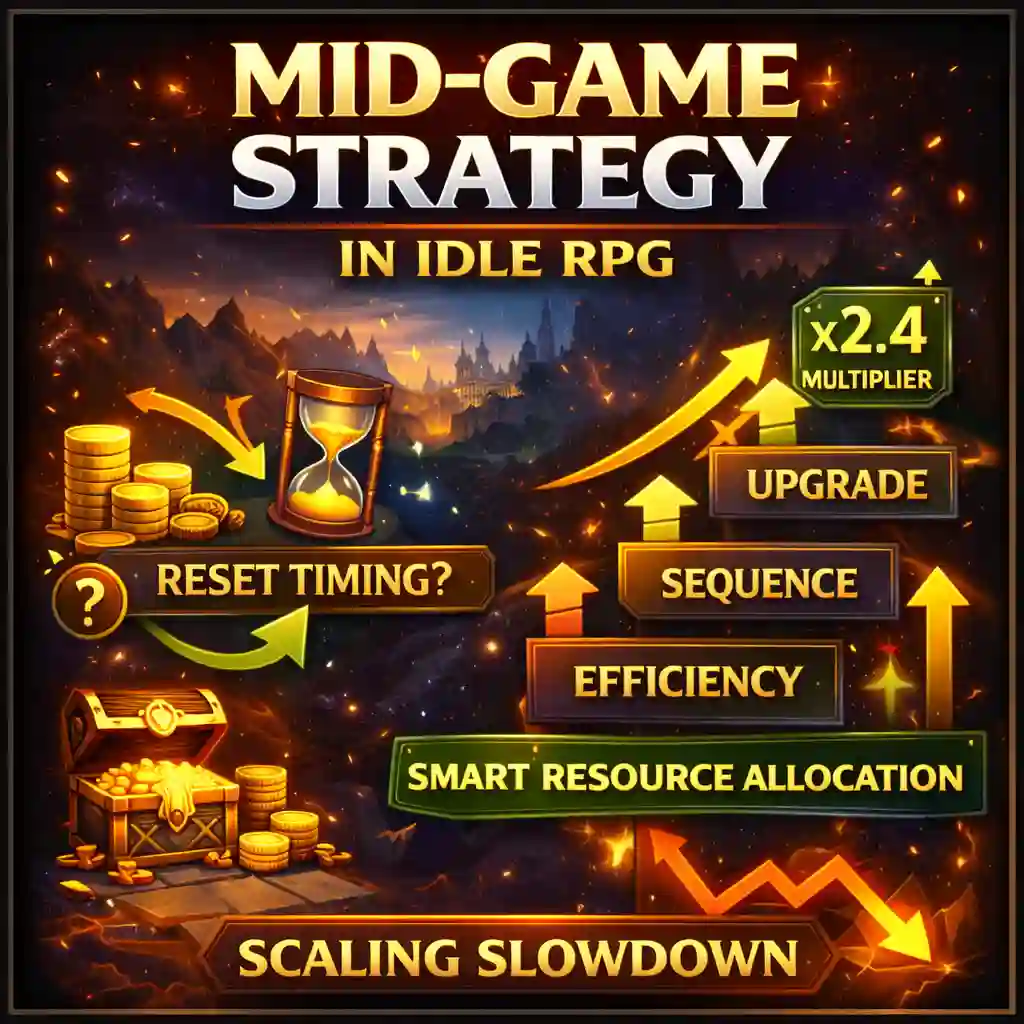
Mid-game strategy in idle RPGs focuses on upgrade sequencing, efficiency timing, and smart resource allocation to overcome scaling slowdowns and maintain sustainable long-term progression.
Mid-game strategy in idle RPGs becomes critical when exponential growth slows, upgrade costs rise, and resource allocation decisions determine long-term efficiency. At this stage, optimization shifts from simple upgrading to sequencing, timing resets, and maximizing multiplier interactions for sustainable scaling.
Introduction: When Idle Stops Being Simple
Early stages of an idle RPG are usually straightforward. Players upgrade damage, unlock features, and watch numbers increase rapidly. Progress feels automatic and forgiving.
However, mid-game marks a turning point.
If you are still learning how idle RPG systems function at a fundamental level, reviewing What Is an Idle RPG? Complete Beginner Explanation can help clarify the core progression loop before diving into deeper strategic layers.
Mid-game is where that loop begins to demand optimization rather than passive upgrading.
Recognizing the Mid-Game Phase
Mid-game typically begins when:
This is the phase where inefficient choices begin to compound negatively.
Unlike early game, where nearly every upgrade feels beneficial, mid-game forces prioritization.
When Optimization Becomes Crucial
Optimization becomes critical when marginal gains matter.
Instead of doubling power easily, players might gain:
At this stage, careless spending delays progression significantly.
Optimization now involves:
The game transitions from growth acceleration to growth management.
Upgrade Sequencing: Order Matters
One of the most overlooked aspects of mid-game strategy is sequencing.
Upgrading randomly may still increase power, but inefficient order reduces compounding potential.
Effective sequencing considers:
The correct order maximizes scaling over time rather than focusing on immediate visible gains.
Mid-game punishes short-term thinking.
Efficiency Timing and Reset Decisions
Prestige or reset systems often become strategically relevant in mid-game.
The key question shifts from “Can I push further?” to “Should I reset now?”
Efficiency timing includes:
Resetting too early wastes potential gains. Resetting too late wastes time.
Mid-game strategy requires recognizing the optimal efficiency window.
Resource Allocation and Opportunity Cost
Mid-game introduces meaningful opportunity cost.
Examples include:
Every decision now has trade-offs.
Efficient players calculate not just what increases power, but what increases long-term growth rate.
Opportunity cost awareness separates casual progression from optimized scaling.
Managing Scaling Slowdown
Scaling slowdown is intentional in idle RPG design. It forces adaptation.
Mid-game strategy focuses on:
Rather than brute-forcing progress, players refine their builds.
This refinement is where strategic depth emerges.
Psychological Shift: From Growth to Optimization
Mid-game represents a psychological transition.
Early game rewards activity.Mid-game rewards understanding.
Players begin:
The gameplay experience shifts from reactive upgrading to proactive planning.
This is the phase where idle RPGs reveal their systemic complexity.
Why Mid-Game Strategy Defines Long-Term Success
Players who fail to adapt in mid-game often experience frustration or stagnation.
Those who embrace optimization:
Mid-game strategy lays the groundwork for advanced optimization later.
Without strong sequencing and efficiency awareness, late-game scaling becomes significantly harder.
Conclusion
Mid-game strategy in idle RPGs is the turning point where optimization becomes essential. Rising costs, slower growth, and layered systems demand careful sequencing, efficiency timing, and resource allocation decisions.
What begins as simple progression evolves into strategic management.
Understanding mid-game optimization ensures sustained growth, smoother transitions into late-game systems, and long-term efficiency in modern idle RPG design.