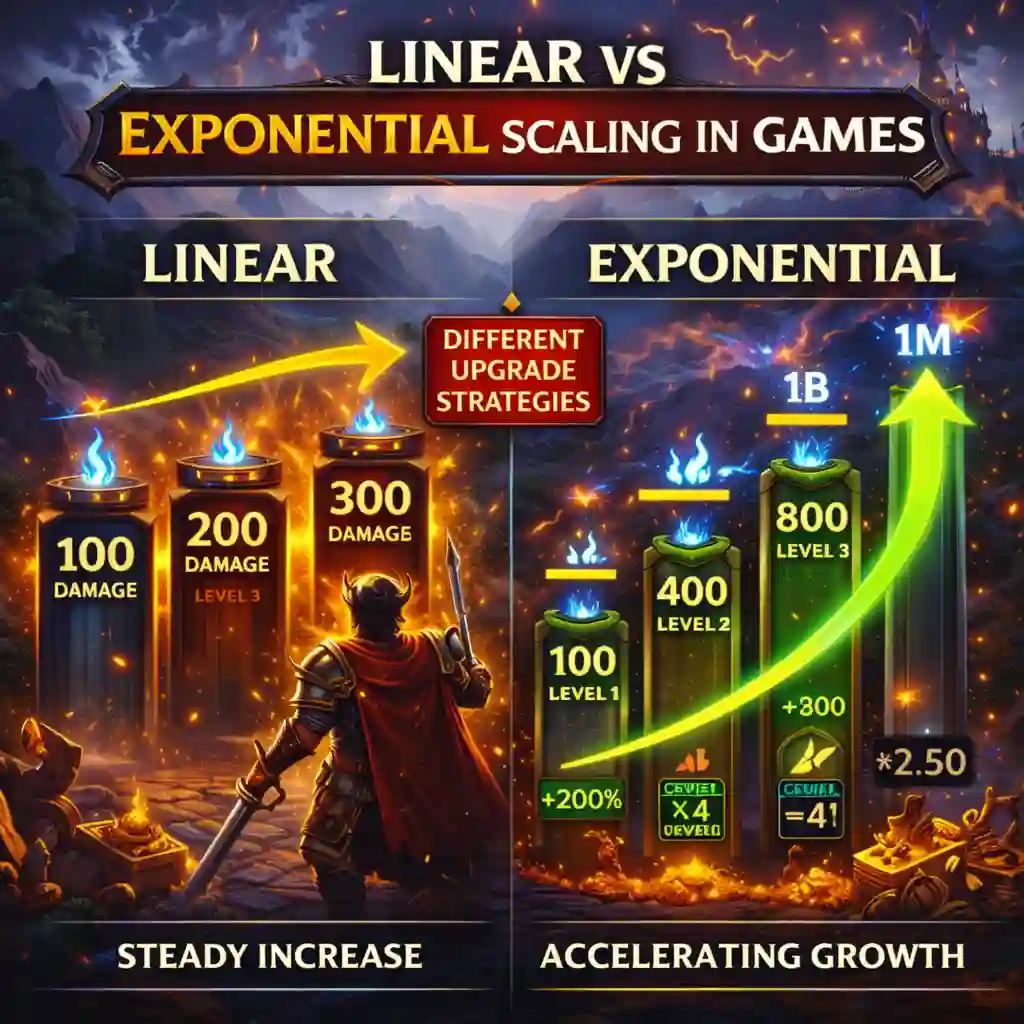
Linear vs Exponential Scaling in Games
Learn the difference between linear and exponential scaling in games, how multiplier stacking drives exponential growth, and why idle RPGs rely on accelerating damage curves for long-term progression.
Linear and exponential scaling describe how player power, enemy difficulty, and progression systems grow over time in a game. Linear scaling increases at a steady rate, while exponential scaling accelerates rapidly as values multiply. Understanding the difference is essential for analyzing idle RPG mechanics, long-term progression balance, and why damage numbers escalate into millions or even billions.
What Is Linear Scaling?
Linear scaling means growth increases by a fixed amount each step.
Example:
Each upgrade adds the same value.
Linear systems are predictable and easy to balance. They are commonly used in early-game progression, traditional RPG stat growth, and fixed upgrade systems. In purely linear systems, growth feels stable but eventually slows relative to increasing enemy difficulty.
What Is Exponential Scaling?
Exponential scaling means growth increases by multiplying rather than adding.
Example:
Instead of adding +100 each time, the value doubles.
In idle games, exponential scaling often looks like:
1K → 10K → 100K → 1M → 1B
This is not random inflation. It is intentional mathematical acceleration driven by multiplier stacking.
Key Differences Between Linear and Exponential Growth
Rate of Increase
Linear growth increases steadily.Exponential growth accelerates over time.
Player Perception
Linear scaling feels controlled and grounded.Exponential scaling feels explosive and dramatic.
Long-Term Sustainability
Linear systems eventually stall if enemy difficulty also increases.Exponential systems can keep pace with rising HP values through multiplier layering.
Why Idle Games Rely on Exponential Scaling
Idle RPGs depend on long-term progression loops. If player damage increased linearly while enemy HP increased exponentially, progression would eventually become impossible.
To maintain forward momentum:
Exponential scaling ensures that even when enemy HP grows massively, players can still surpass it with proper optimization.
Where Linear Scaling Still Exists in Idle Games
Even in idle RPGs dominated by exponential growth, linear elements still play a role.
Early Levels
Initial upgrades often add flat damage or small additive bonuses.
Base Stat Growth
Base attack may increase linearly before multipliers apply.
Cost Scaling
Some upgrade costs increase linearly at first before accelerating.
Linear components form the foundation. Exponential multipliers build on top.
The Role of Multipliers in Exponential Growth
Exponential scaling typically emerges from multiplicative stacking.
For example:
Base Damage × Global Multiplier × Skill Multiplier × Crit Multiplier
Each new multiplier layer increases total output dramatically.
Without multiplier layering, exponential curves would not exist.
Enemy Scaling and Difficulty Curves
Game designers carefully tune enemy HP and damage curves.
If enemy HP grows linearly but player damage grows exponentially:
If both grow exponentially:
Balancing these curves determines how smooth or punishing a game feels.
Common Misconceptions About Exponential Scaling
“Big Numbers Mean Bad Balance”
Large numbers are not inherently problematic. In idle games, inflated numbers reflect mathematical structure, not imbalance.
“Linear Scaling Is Always Better”
Linear systems are easier to understand, but they limit long-term progression depth.
“Exponential Growth Has No Limits”
Most games introduce soft caps, diminishing returns, or cost inflation to prevent runaway scaling.
How Scaling Affects Upgrade Strategy
Understanding scaling helps players prioritize upgrades.
In linear systems:
In exponential systems:
Recognizing which system dominates your game prevents inefficient investment.
Scaling and Prestige Systems
Prestige systems amplify exponential growth by introducing permanent multipliers.
Each reset increases baseline scaling speed.
This creates layered exponential progression:Run-based growth × Permanent bonuses × Multiplier stacking
Linear growth alone would not sustain long-term prestige loops effectively.
Why Understanding Scaling Improves Optimization
When players recognize whether a system scales linearly or exponentially, they can:
Scaling awareness transforms random upgrading into strategic progression planning.
How Scaling Connects to Idle RPG Design
Scaling is one of the core structural pillars of idle RPG mechanics.
Automatic combat depends on scaling efficiency.DPS systems rely on multiplier-driven acceleration.Prestige loops require exponential layering to feel meaningful.
If you want to understand how scaling integrates with automation, DPS, and long-term progression loops, read our main guide: What Is an Idle RPG? Complete Beginner Explanation. That pillar article breaks down how all core systems work together.
Conclusion
Linear scaling increases steadily. Exponential scaling accelerates dramatically.
Idle games rely heavily on exponential growth powered by multipliers and prestige systems to maintain long-term engagement.
Understanding the difference between linear and exponential scaling helps players make smarter upgrade decisions and better predict how progression will evolve over time.