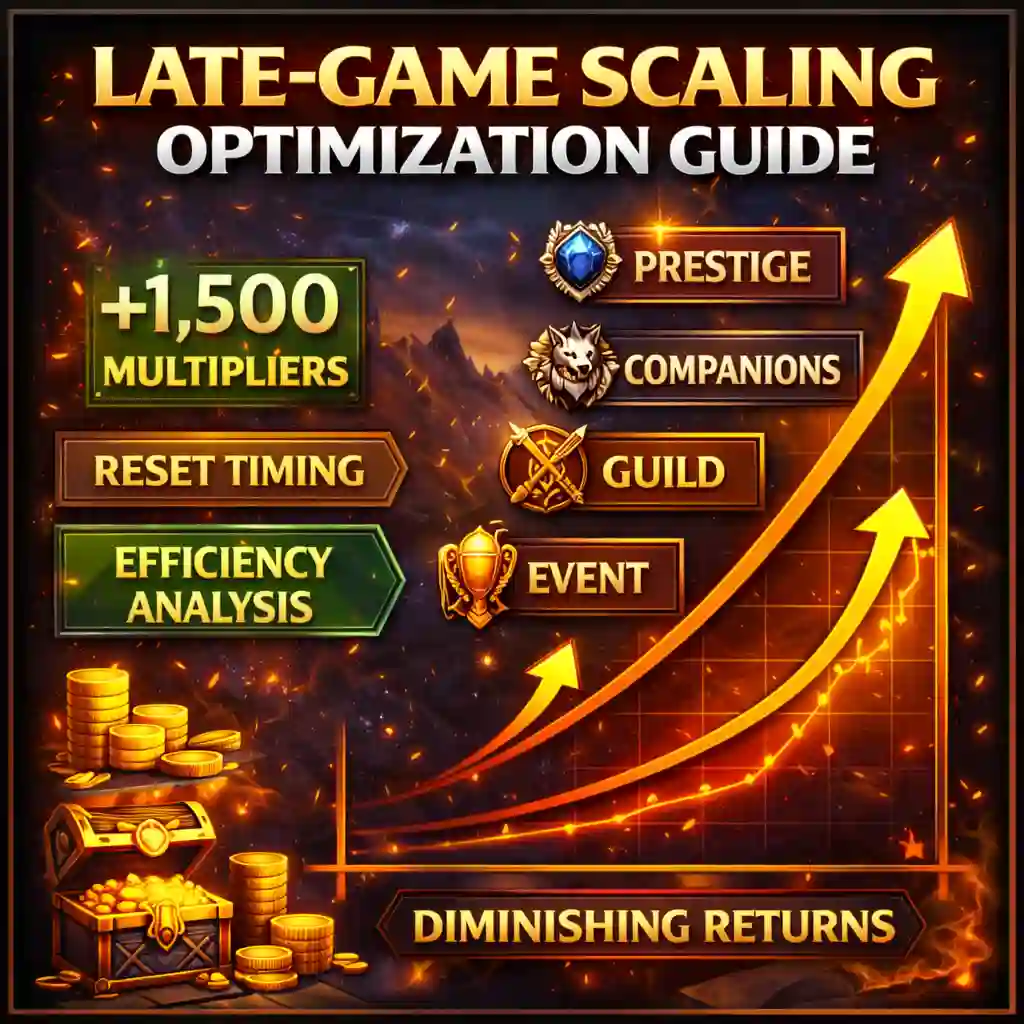
Late-Game Scaling Optimization Guide
Late-game scaling optimization in idle RPGs focuses on advanced multiplier stacking, reset efficiency, and strategic scaling management to sustain exponential growth despite extreme cost inflation and diminishing returns.
Late-game scaling optimization in idle RPGs focuses on advanced multiplier stacking, efficiency analysis, and long-term scaling management to sustain exponential growth despite extreme cost inflation and diminishing returns. At this stage, progression depends less on simple upgrades and more on systemic mastery.
Introduction: When Numbers Stop Growing Easily
Late-game is where idle RPG systems fully reveal their complexity. Exponential costs, diminishing efficiency, and layered mechanics create a progression environment that demands precise optimization.
If you are still building foundational knowledge of how idle RPG systems function, reviewing What Is an Idle RPG? Complete Beginner Explanation can help clarify the core loop before exploring advanced late-game scaling strategies.
Late-game is not about grinding harder. It is about scaling smarter.
Understanding Late-Game Scaling Pressure
In late-game progression, players encounter:
At this point, raw stat upgrades provide minimal impact compared to properly stacked multipliers.
Scaling pressure forces players to analyze systems rather than simply invest resources.
Advanced Multiplier Stacking
Late-game optimization revolves around multiplier architecture.
Common multiplier categories include:
The critical distinction is stacking type.
Multiplicative bonuses dramatically outperform additive ones when layered correctly. Late-game builds prioritize multiplicative chains to maximize compounding effects.
For example:
Base Damage × Prestige × Companion × Guild × Event Buff
Even modest multipliers create massive output when stacked multiplicatively.
Understanding stacking hierarchy is essential for sustaining late-game scaling.
Efficiency Analysis and ROI Modeling
In late-game environments, every upgrade must justify its cost.
Efficiency analysis includes:
Players often evaluate:
Late-game scaling becomes a mathematical decision process rather than an emotional one.
Managing Diminishing Returns
Diminishing returns are deliberately implemented to prevent infinite runaway scaling without strategy.
Effective late-game management includes:
When one system reaches reduced efficiency, optimization shifts to another layer.
This rotational scaling strategy maintains momentum.
Prestige Timing at High Tiers
Late-game prestige decisions differ significantly from mid-game resets.
Key considerations include:
Resetting too early sacrifices compounding potential. Resetting too late wastes high-cost stagnation time.
Advanced players model reset timing around multiplier breakpoints rather than arbitrary progression walls.
Scaling Management Across Systems
Late-game optimization requires balancing multiple systems simultaneously.
These often include:
Scaling management involves synchronizing these systems so that one layer amplifies another.
Fragmented progression reduces compounding efficiency.
Integrated progression maximizes systemic output.
Psychological Endurance and Strategic Discipline
Late-game progression tests patience and discipline.
Growth becomes incremental rather than explosive. Gains may appear small but carry significant compounded value over time.
Players who succeed in late-game optimization:
The experience shifts from reward-driven excitement to mastery-driven satisfaction.
Why Late-Game Optimization Defines Mastery
Late-game is where casual players plateau and strategic players advance.
Mastery includes:
Without advanced optimization, late-game scaling becomes unsustainable.
With proper multiplier stacking and efficiency management, growth continues despite extreme cost curves.
Conclusion
Late-game scaling optimization in idle RPGs requires advanced multiplier stacking, disciplined efficiency analysis, and dynamic scaling management. As progression slows and costs escalate, only systemic understanding sustains growth.
Late-game is not about increasing numbers faster. It is about engineering progression systems to work together.
In modern idle RPG design, late-game optimization represents the ultimate test of strategic depth and long-term scaling mastery.