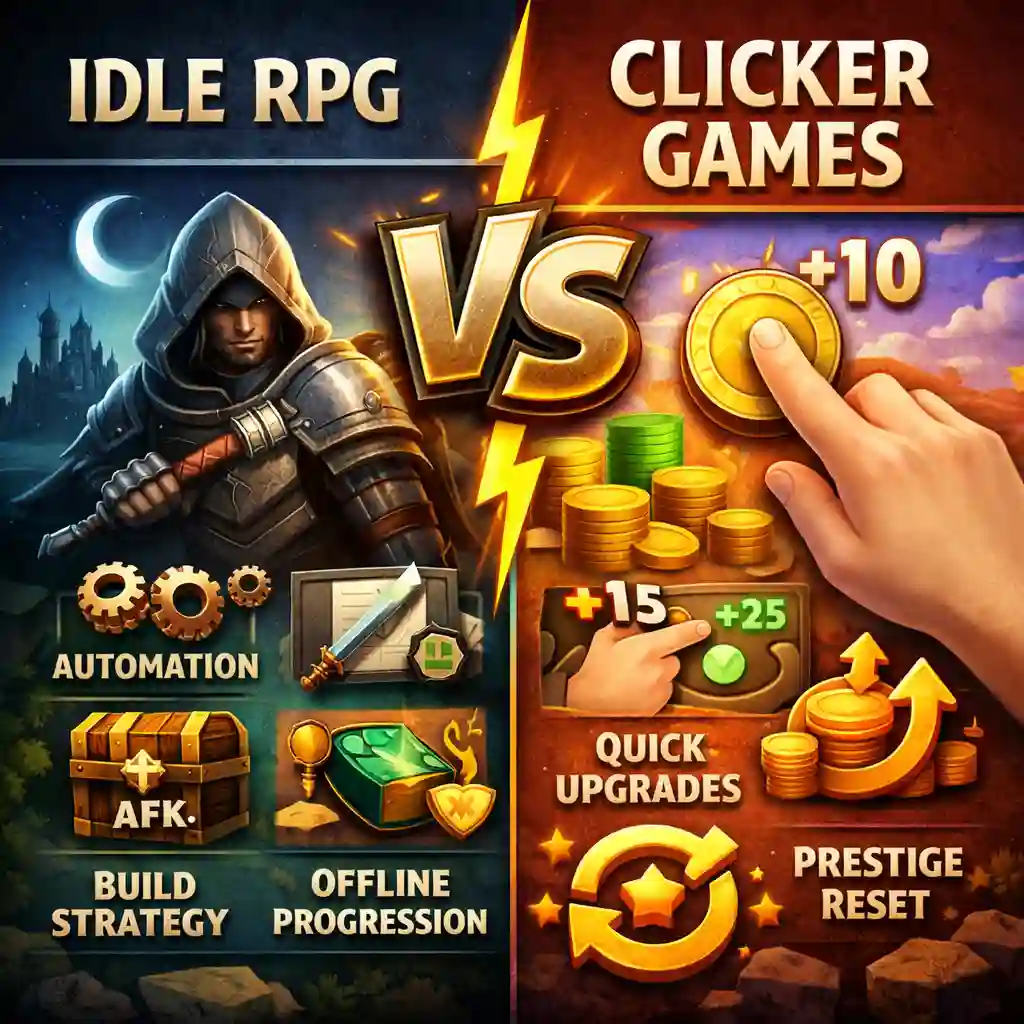
Idle vs Clicker Games: Full Comparison Guide
Idle RPG vs Clicker Games explained in a complete side-by-side comparison. Learn the key differences in mechanics, automation, interaction depth, and long-term progression systems.
Idle RPGs and clicker games are often grouped together, but they differ significantly in mechanics, player interaction, progression systems, and long-term strategic depth. This guide provides a complete side-by-side comparison to help you understand how each genre works, who they are designed for, and which one fits your preferred playstyle.
Introduction: Why People Confuse Idle and Clicker Games
At first glance, idle RPGs and clicker games look almost identical. Both genres revolve around increasing numbers, exponential scaling, upgrades, and progression systems. You defeat enemies, earn currency, buy improvements, and repeat the loop.
However, the similarity ends at the surface level.
Clicker games are built around active input as the core mechanic. Idle RPGs, in contrast, prioritize automation, optimization, and long-term character development. While both may share incremental design elements, their interaction depth and progression philosophy are fundamentally different.
If you're still unsure what defines the idle RPG genre at its core, you may want to read our foundational guide: What Is an Idle RPG? Complete Beginner Explanation, which breaks down the essential structure and design principles behind idle RPG systems.
Core Mechanics Comparison
Clicker Games: Manual Interaction First
Clicker games are driven by direct player input. Tapping or clicking generates damage, currency, or progress. The faster you click, the faster you advance.
Typical core mechanics include:
While automation eventually appears in many clicker games, manual input remains central to early and mid-game design.
Examples of classic clicker mechanics:
The gameplay loop is straightforward: click → earn → upgrade → click faster.
Idle RPGs: Automation and Systems Design
Idle RPGs focus on background progression. Combat, farming, and resource generation continue even when the player is offline.
Core mechanics typically include:
The primary engagement is not physical clicking speed, but strategic decision-making.
Players optimize builds, experiment with stat distributions, and plan long-term scaling rather than spam input repeatedly.
Interaction Depth: Active vs Strategic Engagement
One of the biggest differences lies in how players interact with the game.
Clicker Interaction Model
Clicker games reward:
They are highly accessible and easy to understand. New players can jump in instantly with no complex system knowledge.
However, interaction depth often remains limited. The complexity comes from scaling numbers rather than layered systems.
Idle RPG Interaction Model
Idle RPGs reward:
The engagement shifts from mechanical input to strategic analysis.
Instead of asking “How fast can I click?”, the question becomes:
This creates deeper cognitive engagement compared to traditional clicker loops.
Progression Structure: Linear vs Layered Growth
Clicker Games Progression
Clicker progression typically follows a linear scaling curve:
The core loop remains mostly consistent throughout the experience.
Idle RPG Progression
Idle RPG progression is more layered and system-based:
Rather than a single power multiplier, idle RPGs stack multiple progression layers simultaneously.
This layered structure makes the late game significantly more complex compared to most clicker games.
Automation Philosophy
Automation is the defining difference between the two genres.
In clicker games:Automation supplements manual input.
In idle RPGs:Automation replaces manual input.
Idle RPGs are intentionally designed so that optimal play does not require constant tapping. Many modern players prefer this design because it allows background progression without repetitive actions.
Strategic Complexity
Clicker Games:
Idle RPGs:
Idle RPGs often overlap with incremental and RPG design principles, which is why genre classification discussions continue among players.
Player Type Comparison
Clicker Games Are Ideal For:
Idle RPGs Are Ideal For:
Your preference depends entirely on whether you enjoy active interaction or passive strategic management.
Which Genre Has Better Longevity?
Generally speaking, idle RPGs offer stronger long-term retention due to:
Clicker games can be highly addictive in the short term but may feel repetitive once automation fully replaces manual clicking.
That said, high-quality clicker games with well-designed prestige systems can maintain player engagement for long periods as well.
Final Verdict: Idle RPG vs Clicker Games
Both genres share incremental DNA, but their design goals differ.
Clicker games focus on active engagement and immediate feedback.Idle RPGs focus on automation, strategic optimization, and layered progression systems.
If you enjoy fast-paced tapping and simple scaling mechanics, clicker games may suit you better.
If you prefer automation-driven progression with deeper systems, character builds, and long-term scaling strategy, idle RPGs provide a more complex experience.
Understanding the distinction helps you choose games aligned with your playstyle—and helps clarify why these genres, while related, are not identical.
If you want to understand the foundational definition of the genre before diving deeper into comparisons, start with our complete beginner guide: What Is an Idle RPG? Complete Beginner Explanation.