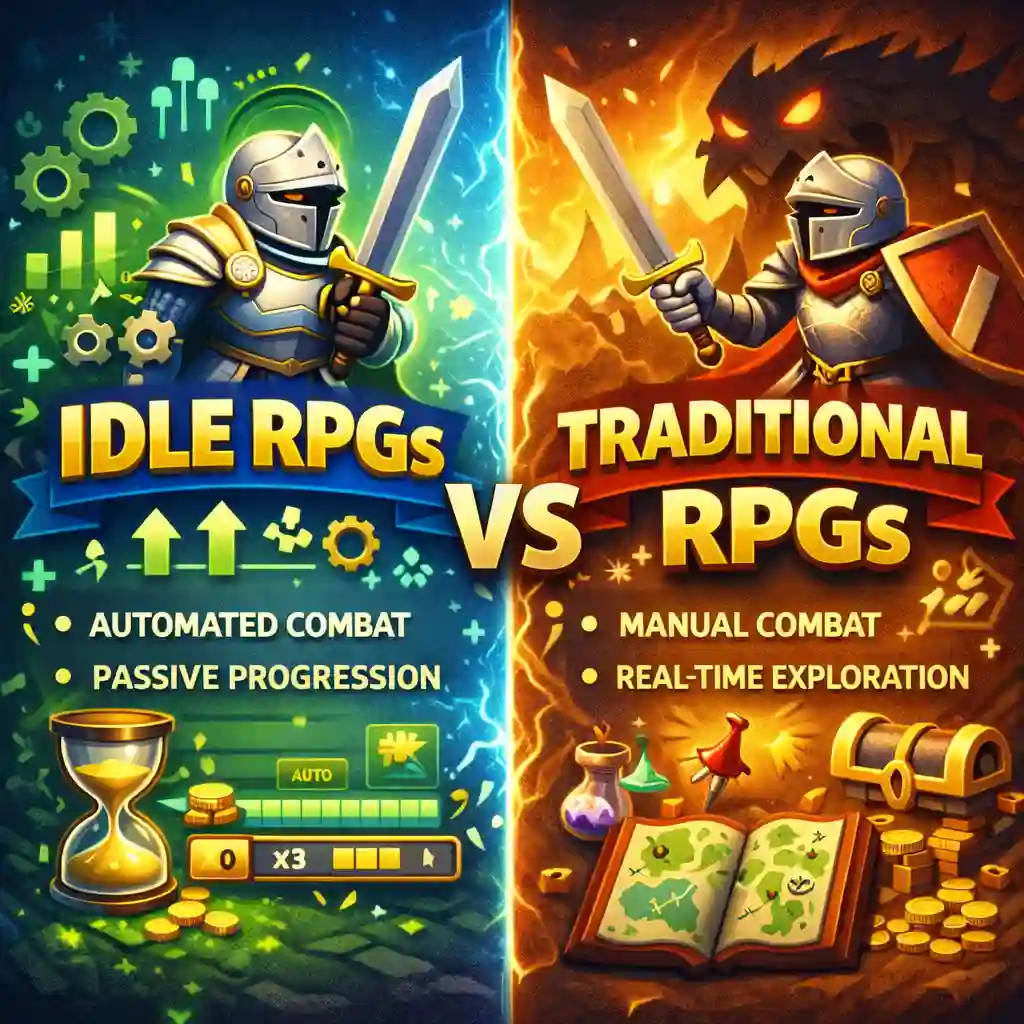
Idle RPG Meaning vs Traditional RPG
Compare idle RPGs and traditional RPGs to understand their key differences in combat, progression systems, automation, and player involvement within modern role-playing game design.
Idle RPGs and traditional RPGs both belong to the role-playing genre, but they differ significantly in how progression happens. While traditional RPGs emphasize manual control, exploration, and active combat, idle RPGs automate core systems and focus on long-term strategic growth. The difference lies not in character progression itself, but in how that progression is executed.
Core Similarities Between Idle RPGs and Traditional RPGs
Despite structural differences, both idle RPGs and traditional RPGs share foundational RPG elements.
These include:
• Character leveling systems
• Stats and attributes
• Equipment progression
• Skills and abilities
• Scaling enemy difficulty
• Long-term character growth
In both formats, players develop a character over time. Builds matter. Upgrade paths matter. Efficiency matters. The RPG identity remains intact because structured progression is central.
The Main Difference: Active vs Automated Gameplay
The most significant difference between idle RPGs and traditional RPGs is the level of manual involvement required.
In traditional RPGs, players manually:
• Control character movement
• Engage in combat
• Explore environments
• Trigger abilities
• Interact with the world in real time
Progress depends heavily on direct player input.
In idle RPGs, many of these systems are automated. Combat often runs automatically. Resources accumulate passively. Experience increases over time without constant interaction.
The player’s role shifts from active controller to system optimizer.
Combat Design Comparison
Traditional RPG combat is typically interactive. Whether turn-based or real-time, players directly influence every encounter through tactical decisions or mechanical execution.
Idle RPG combat, by contrast, often runs in the background. Players influence outcomes through:
• Stat upgrades
• Equipment optimization
• Skill selection
• Multiplier stacking
The emphasis is on preparation rather than execution. Success depends less on reflexes and more on long-term system efficiency.
Time Investment and Player Engagement
Traditional RPGs usually require continuous attention. Exploration, dialogue, quests, and combat demand sustained focus.
Idle RPGs are designed for intermittent engagement. Players may check in periodically, upgrade systems, and allow automation to handle progression between sessions.
Time itself becomes a progression engine. Instead of asking “How well can you control the character right now?” idle RPGs ask “How efficiently have you built your systems?”
Exploration and World Interaction
Traditional RPGs often feature expansive worlds, story-driven quests, and interactive environments. Exploration is a core part of the experience.
Idle RPGs generally minimize direct exploration. Progression tends to occur through stages, waves, or automated dungeon runs rather than open-world traversal.
The focus shifts from narrative immersion to progression scaling.
Progression Depth and Scaling Systems
Both genres can have deep progression systems, but idle RPGs often emphasize exponential scaling more heavily.
Idle RPGs frequently include:
• Prestige or reset systems
• Ascension mechanics
• Multi-layered upgrade trees
• Compounding multipliers
Traditional RPGs may include endgame scaling, but they typically balance progression around story arcs and difficulty curves rather than infinite growth loops.
Which One Is “More RPG”?
The question of whether idle RPGs are “real” RPGs often arises due to their automated structure.
However, genre classification depends on structured character progression, not input intensity. If a game includes persistent leveling systems, stats, equipment progression, and meaningful build decisions, it qualifies as an RPG even if combat is automated.
For a broader foundational explanation of how idle systems integrate with RPG mechanics, read:
What Is an Idle RPG? Complete Beginner Explanation
That guide explains how automation and role-playing systems merge in modern game design.
Who Prefers Each Style?
Traditional RPGs appeal to players who enjoy immersive storytelling, exploration, and hands-on combat.
Idle RPGs appeal to players who enjoy optimization, scaling systems, and long-term strategic growth without constant active play.
Neither is inherently superior. They simply prioritize different aspects of the role-playing experience.
Conclusion
Idle RPGs and traditional RPGs share the same structural foundation: character progression, stats, skills, and long-term development. The difference lies in how that progression unfolds.
Traditional RPGs rely on active control and real-time engagement. Idle RPGs rely on automation and system optimization.
Both belong within the RPG genre. They represent different design philosophies built on the same core principle, structured character growth over time.