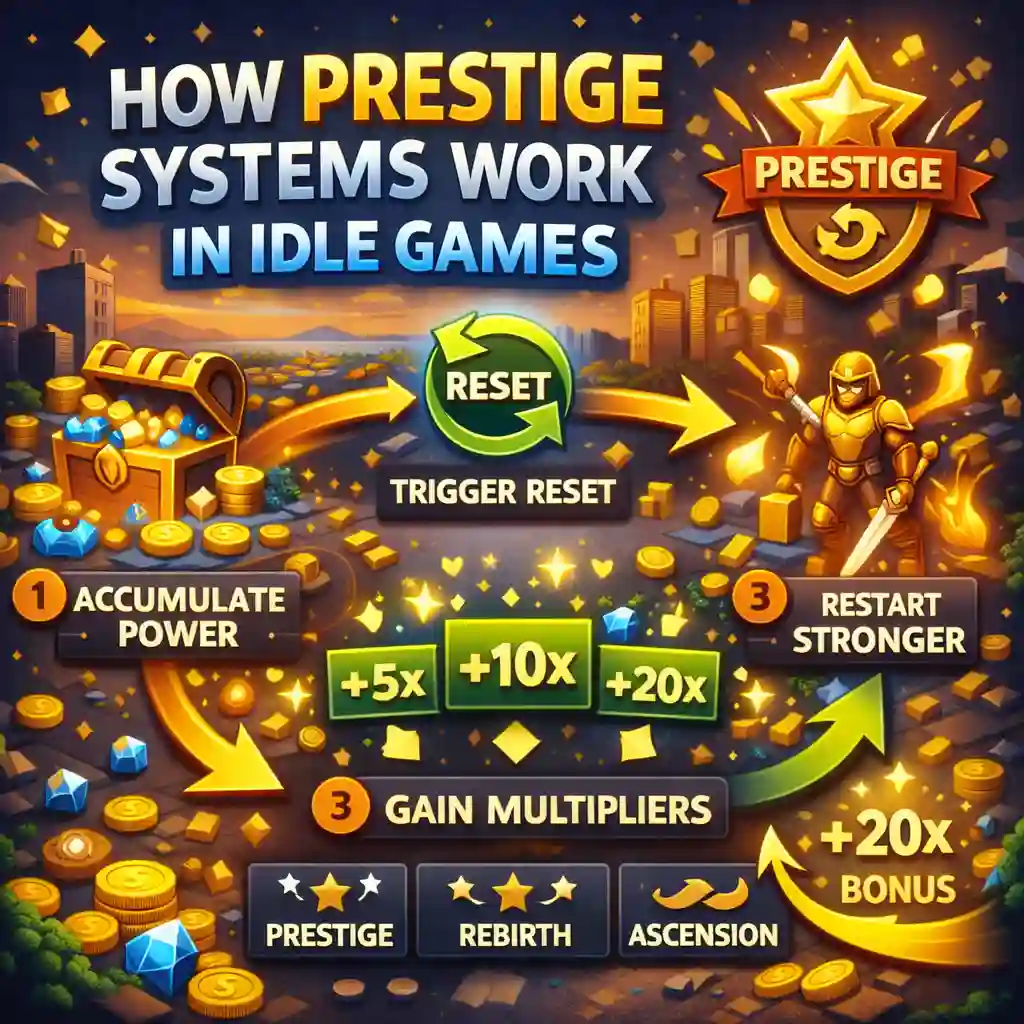
How Prestige Systems Work in Idle Games
Learn how prestige systems work in idle games, including reset loops, multiplier carry-over, and meta progression layers that turn resets into exponential long-term power growth.
Prestige systems in idle games are structured reset mechanics that exchange short-term progress for permanent multipliers, accelerating long-term growth. By restarting runs with stronger bonuses, players scale faster each cycle, turning repetition into exponential power through meta progression layers.
What Is a Prestige System?
A prestige system is a mechanic that allows players to reset part or all of their progress in exchange for permanent bonuses. These bonuses usually increase production, damage output, currency gain, or unlock entirely new systems.
At first glance, resetting seems like losing progress.
In reality, prestige is about transforming temporary growth into permanent acceleration.
Instead of reaching a hard cap and stopping, players recycle their progress into long-term multipliers. Each new run becomes faster and more powerful than the last.
The Core Prestige Loop
Prestige systems follow a clear structural loop:
This loop converts stagnation into momentum.
Rather than hitting a wall and quitting, players reset strategically. The early game, once slow, now becomes trivial. Mid-game barriers collapse. Late-game scaling accelerates dramatically.
That sense of increasing efficiency across runs is the emotional core of prestige design.
Multiplier Carry-Over and Permanent Bonuses
The most important feature of prestige systems is multiplier carry-over.
When players reset, they typically earn a special currency or bonus that persists across runs. This bonus might:
These bonuses stack multiplicatively with existing systems.
For example:
Base damage × equipment bonus × skill multiplier × prestige bonus
Even if base stats reset, the prestige multiplier amplifies every future stat increase. Over multiple cycles, the compounded effect becomes enormous.
This is why prestige systems are often tightly connected to exponential growth models.
Why Resetting Makes You Stronger
Resetting feels counterintuitive. Players are conditioned to avoid losing progress.
Prestige systems reframe loss as investment.
When designed correctly, a reset does three important things:
First, it shortens early progression. What once took hours may now take minutes.
Second, it increases scaling potential. Each reset raises the growth ceiling.
Third, it introduces meta progression. Players are no longer just increasing numbers, they are improving the growth engine itself.
The key psychological shift is this: progress is no longer measured in current stats, but in long-term efficiency.
Meta Progression Layers
Meta progression refers to systems that operate above the core gameplay loop.
Prestige is often the first meta layer, but many idle games include multiple tiers:
Each layer resets deeper portions of the game while granting stronger permanent multipliers.
These layers extend longevity. Instead of designing infinite new content manually, developers create recursive growth systems.
If you want to understand how prestige fits into the broader structure of idle RPG progression, including combat automation, scaling mechanics, and layered systems, the foundation is explained in What Is an Idle RPG? Complete Beginner Explanation, where scaling and reset loops form the backbone of long-term design.
Strategic Prestige Timing
Prestige systems are not just about resetting, they are about timing.
Reset too early, and the bonus may be inefficient.Reset too late, and progression slows dramatically.
Many players optimize around prestige breakpoints. They calculate when multiplier gain outweighs continued grinding.
This strategic layer deepens engagement. Players are not simply waiting for numbers to rise; they are making decisions that affect long-term scaling.
Optimization transforms prestige from a mechanic into a strategy system.
Prestige and Exponential Growth
Prestige mechanics are closely tied to exponential growth curves.
Without resets, exponential scaling eventually reaches practical or content limits. With prestige, scaling loops can continue indefinitely.
Each reset:
This recursive amplification is what allows idle games to display numbers in the trillions, quadrillions, and beyond without breaking structure.
Prestige turns exponential growth into cyclical exponential growth.
Emotional Impact of Reset Systems
Prestige systems create powerful emotional dynamics:
Instead of burnout, players experience renewal.
The reset moment becomes a milestone, not a punishment.
When executed well, prestige systems feel like leveling up the entire game rather than just the character.
Common Prestige Design Variations
Different games implement prestige in different ways:
Soft ResetOnly certain resources reset while core upgrades remain.
Hard ResetMost progress resets, but permanent meta bonuses remain.
Tiered ResetMultiple layers unlock sequentially, each stronger than the last.
Currency-Based PrestigePlayers earn a special prestige currency proportional to their current power.
Each variation changes pacing, optimization depth, and long-term retention structure.
Conclusion
Prestige systems work by transforming temporary progress into permanent acceleration. Through structured reset loops, multiplier carry-over, and layered meta progression, players become stronger with each cycle.
Resetting does not erase progress, it amplifies it.
By reframing repetition as exponential empowerment, prestige systems extend game lifespan, deepen strategic engagement, and create some of the most satisfying long-term progression loops in idle game design.