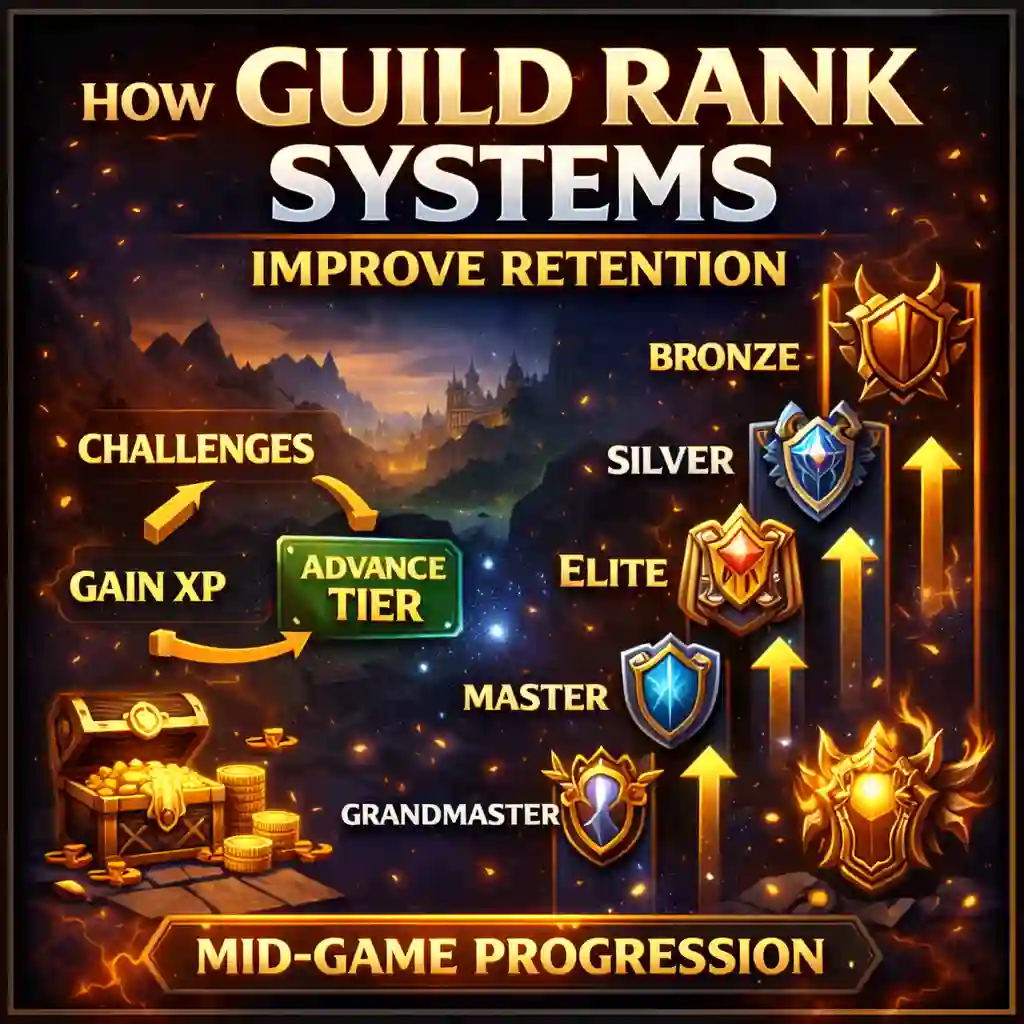
How Guild Rank Systems Improve Retention
Guild rank systems in idle RPGs improve retention through structured progression ladders, milestone unlocks, and engagement loops that provide clear long-term goals beyond simple DPS scaling.
Guild rank systems in idle RPGs improve retention by introducing structured progression ladders, milestone-based unlocks, and long-term engagement loops that extend gameplay beyond simple DPS growth. By providing clear goals and tiered rewards, ranking systems transform passive progression into sustained strategic commitment.
Introduction: Progression Beyond Raw Power
Idle RPGs often begin with straightforward number growth higher damage, faster resource gain, and incremental upgrades. However, modern design introduces structured progression systems that give players directional goals.
If you are exploring how idle RPG mechanics evolve beyond basic automation, you may first want to understand the genre’s foundation in What Is an Idle RPG? Complete Beginner Explanation, which outlines core progression loops before examining advanced layers like guild ranking systems.
Guild rank systems represent one of the most effective retention mechanisms in contemporary idle RPG design.
The Ranking Ladder as a Long-Term Goal Structure
A guild rank system typically functions as a progression ladder.
Players:
Unlike raw DPS growth, which can feel abstract, rank advancement provides visible status progression. Each tier acts as a psychological checkpoint.
Clear progression tiers create:
This laddered structure reduces ambiguity in player direction and increases engagement consistency.
Milestone Unlocks and Content Gating
Guild ranks often unlock:
This gating mechanism ensures that progression unfolds gradually rather than all at once.
From a retention perspective, structured unlocking prevents early content exhaustion. Instead of overwhelming players with all systems simultaneously, guild ranks pace the experience.
Each new rank signals access to deeper complexity, encouraging continued participation.
Engagement Loops Within Guild Systems
Retention is strengthened through recurring engagement loops embedded within ranking systems.
Common loops include:
This loop creates escalating objectives. As challenges increase, rewards scale accordingly.
Players are motivated not only by power growth but also by status progression within the guild hierarchy.
Structured loops convert passive idle mechanics into cyclical engagement systems.
Psychological Impact of Visible Rank Progression
Visible ranks provide social and psychological reinforcement.
Even in single-player idle RPGs, rank titles such as:
Create aspirational identity markers.
Rank systems reinforce:
Unlike hidden stat scaling, ranks are explicit. They externalize growth.
This clarity reduces player fatigue because progression is easier to interpret and measure.
Mid-Game Stabilization Through Guild Progression
During mid-game, players often experience stagnation as upgrade costs increase and scaling slows.
Guild rank systems mitigate this stagnation by introducing alternative progression vectors.
Instead of relying solely on stat upgrades, players can:
This diversification prevents mid-game drop-off, a common retention issue in incremental games.
Guild progression acts as a stabilizing system when raw scaling becomes less immediately rewarding.
Long-Term Retention Through Tier Escalation
High-tier guild ranks typically introduce:
This escalation ensures that endgame progression remains meaningful.
Rather than reaching a soft cap, players encounter expanding tiers that extend gameplay duration.
The structured ladder gives players a roadmap for long-term commitment.
Retention improves when players can visualize how far they have progressed — and how far they still can go.
Design Perspective: Why Guild Rank Systems Work
From a design standpoint, guild ranking systems:
They complement base scaling systems by offering visible advancement rather than purely numerical growth.
Guild ranks transform idle gameplay from open-ended scaling into structured progression.
Conclusion
Guild rank systems improve retention in idle RPGs by creating clear progression ladders, milestone-based unlocks, and cyclical engagement loops. They offer visible advancement, structured pacing, and aspirational tier progression that sustain long-term player commitment.
By combining measurable status growth with content gating and escalating objectives, guild systems anchor player motivation beyond simple stat increases.
In modern idle RPG design, structured ranking is not optional it is a central pillar of long-term retention strategy.