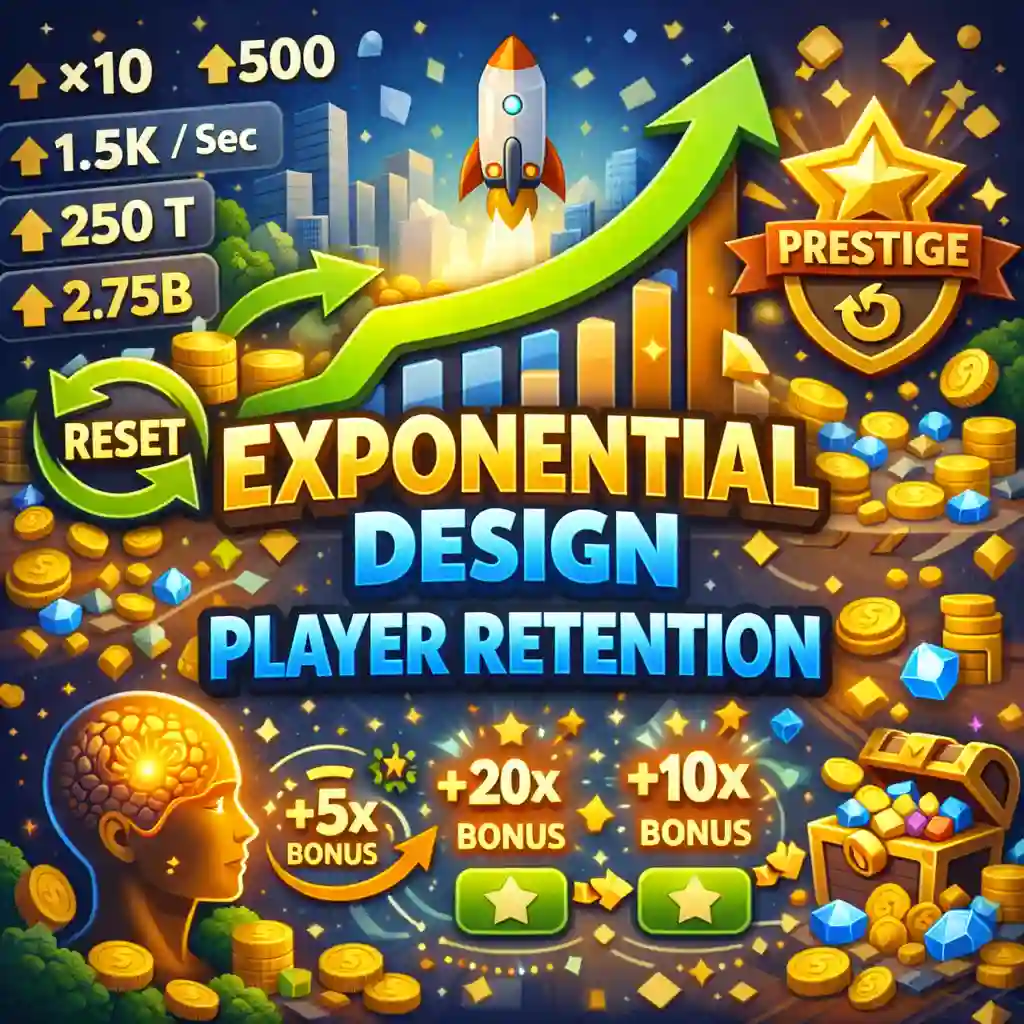
How Exponential Design Drives Player Retention
Learn how exponential design drives player retention through compounding rewards, structured reset systems, and accelerating progression loops that keep players engaged long term.
Exponential design drives player retention by creating accelerating progress, compounding rewards, and long-term engagement loops that keep players invested over time. By stacking multipliers, structured resets, and breakthrough moments, developers transform short-term actions into sustained psychological momentum.
Understanding Retention in Game Design
Retention is not just about keeping players online. It is about giving them a reason to return.
In modern game design, especially in incremental and idle genres, retention depends on perceived growth. If players feel stronger each session, they come back. If growth stagnates, they leave.
Exponential systems solve this problem by ensuring that progress accelerates rather than plateaus permanently.
Instead of offering fixed rewards, exponential design multiplies rewards. This multiplication changes how players interpret effort. One upgrade does not simply add power it amplifies future potential.
That shift is critical.
Compounding Rewards and Long-Term Motivation
Compounding rewards are at the core of exponential design.
When systems stack multiplicatively rather than additively, each improvement enhances the value of every future improvement. This creates a growth engine.
For example:
Instead of adding up to 10, these multiply to 30. The impact is dramatically larger.
This compounding structure creates a forward-looking mindset. Players begin thinking about optimization, timing, and synergy. They are no longer reacting to rewards they are planning for exponential breakthroughs.
That anticipation builds long-term motivation.
The Power of Breakthrough Moments
Retention thrives on emotional spikes.
Exponential systems allow developers to engineer “breakthrough moments” where progress suddenly accelerates. These moments may occur when:
These spikes reset player excitement. Even if progression slows temporarily, players know another breakthrough exists ahead.
This forward promise is one of the strongest long-term hooks in incremental design.
Structured Reset Systems and Retention Loops
One of the most effective retention tools in exponential design is the reset loop.
Prestige systems, rebirth mechanics, or ascension tiers intentionally reset short-term progress while granting permanent multipliers.
At first glance, resetting seems counterproductive. In reality, it strengthens retention.
Here is why:
Each reset reframes repetition as empowerment.
If you want to understand how these exponential and reset mechanics integrate into broader role-playing systems, the foundation is explained in What Is an Idle RPG? Complete Beginner Explanation, where scaling becomes the structural backbone of idle RPG progression.
Perceived Acceleration as a Retention Driver
Perceived acceleration is more important than raw numbers.
When players feel that growth is speeding up, they experience momentum. Momentum reduces churn because it creates emotional attachment to progress.
Even if the mathematical curve is carefully controlled, UI feedback, visual explosions, and dramatic number increases amplify perceived speed.
Designers often combine:
This pacing structure keeps engagement stable across different player types.
Casual players enjoy early growth.Strategic players enjoy mid-game optimization.Long-term players chase late-game exponential scaling.
The result is layered retention.
Exponential Design and Habit Formation
Retention is not only about excitement. It is also about habit.
Exponential systems encourage players to return because:
Each session feels meaningful, even if short.
Because progress compounds, missing a session feels like missing acceleration. This psychological framing strengthens return behavior without requiring aggressive monetization tactics.
Avoiding Retention Burnout
Exponential design must be balanced carefully.
If growth accelerates too rapidly, content burns out.If growth stalls too long, players disengage.
Successful retention models introduce:
These design tools create rhythm. Players experience buildup, explosion, stabilization, then renewed acceleration.
Without rhythm, exponential systems lose emotional impact.
Long-Term Hooks in Exponential Games
The strongest retention systems combine three elements:
Short-term satisfaction comes from immediate upgrades.Mid-term optimization comes from multiplier synergy.Long-term scaling comes from prestige and meta-progression.
When all three layers interact, the game sustains engagement for weeks, months, or even years.
Players are not just increasing numbers. They are building engines.
Why Exponential Design Scales So Well
From a production standpoint, exponential design is efficient.
Instead of constantly creating handcrafted levels, developers create scalable systems. New content tiers can plug into existing multipliers. Reset layers can extend lifespan without redesigning core mechanics.
This scalability benefits both players and developers.
Players experience long-term growth.Developers maintain sustainable content cycles.
That alignment is rare in other progression models.
Conclusion
Exponential design drives player retention by transforming simple actions into compounding momentum. Through multiplier stacking, structured reset loops, breakthrough moments, and perceived acceleration, games create powerful long-term engagement systems.
Retention is not forced it is engineered through growth.
When players feel that each session amplifies future potential, they remain invested. Exponential systems do not just increase numbers. They build emotional attachment, strategic depth, and sustainable long-term hooks that keep players coming back.