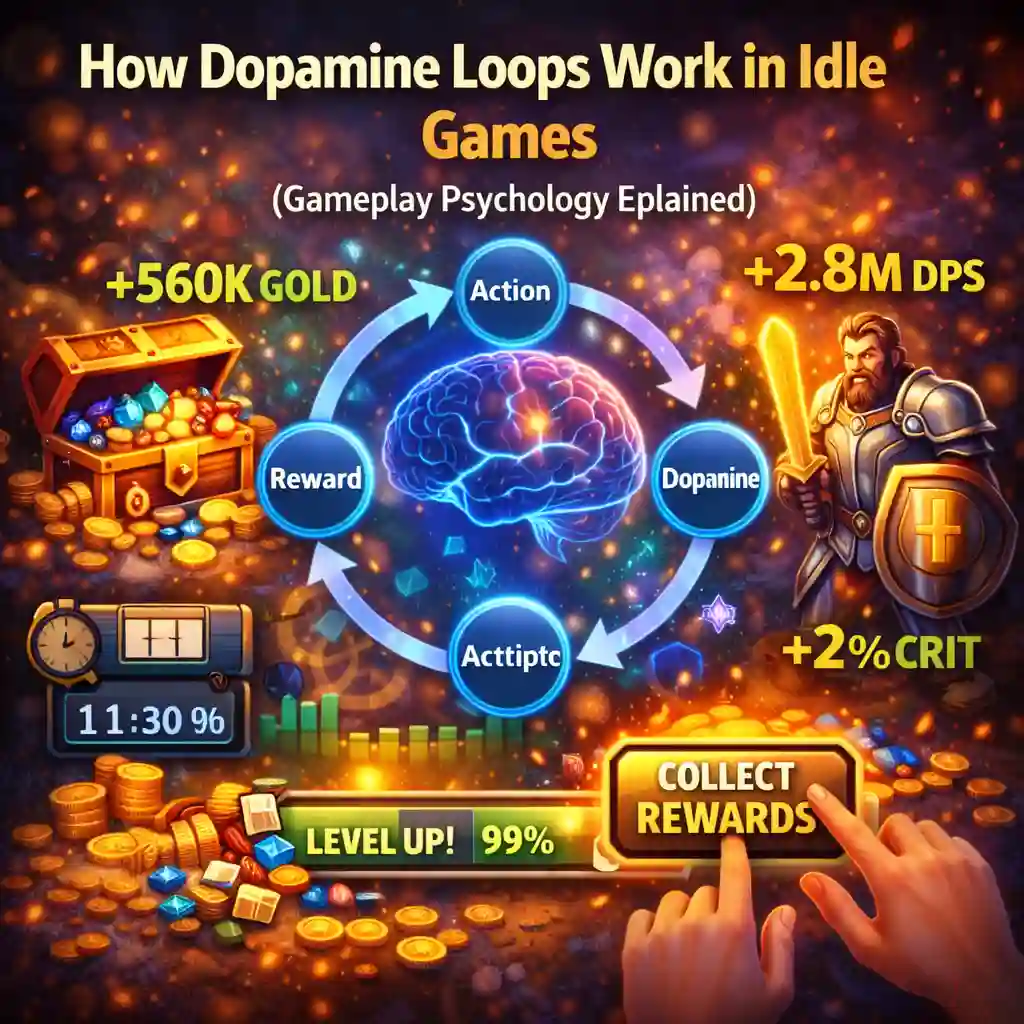
How Dopamine Loops Work in Idle Games
How do dopamine loops work in idle games? Discover how micro rewards, repetition, small wins, and reinforcement cycles drive long-term engagement and habit formation.
Dopamine loops in idle games function through small, repeated rewards that reinforce behavior over time. By delivering micro wins, visible feedback, and predictable progression cycles, idle systems condition players to return regularly, creating sustainable engagement through structured reinforcement.
Introduction: The Power of Small Wins
Idle games rarely rely on dramatic cutscenes or intense skill-based gameplay. Instead, they thrive on something much subtler: small, repeated victories.
A stat increases.Gold accumulates.A multiplier activates.An upgrade unlocks.
Each moment is minor on its own, but together, they form a powerful behavioral loop.
If you’re new to how idle systems structure these progression mechanics, you may want to begin with What Is an Idle RPG? Complete Beginner Explanation, which outlines the foundational gameplay framework before examining the neurological mechanisms behind it.
Now let’s explore how dopamine loops actually work.
1. What Is Dopamine, and What It Really Does
Dopamine is often described as the “pleasure chemical,” but that description is incomplete.
In neuroscience, dopamine is more accurately linked to:
Rather than creating pleasure itself, dopamine signals that something important has happened, or is about to happen.
When a game provides a reward after an action, dopamine pathways reinforce that behavior.
Action → Reward → Dopamine Response → Increased Likelihood of Repetition
Idle games are structured to repeat this loop continuously.
2. Micro Rewards: The Foundation of Idle Design
Idle systems rarely make players wait long for feedback.
Instead, they provide:
These micro rewards are intentionally frequent.
Each small improvement confirms progress. Even if the gain is minimal, the confirmation reinforces engagement.
The key insight is this:
The brain responds to progress, not just magnitude.
Small wins delivered consistently are often more powerful than rare, massive rewards.
3. Repetition and Behavioral Conditioning
Behavioral psychology, influenced by researchers like B. F. Skinner, demonstrated that repeated reinforcement shapes habits.
Idle games mimic structured reinforcement schedules by:
The repetition strengthens neural pathways.
Over time, checking the game becomes habitual.
Not because of dramatic events, but because of reliable micro reinforcement.
4. Anticipation: The Hidden Driver
Dopamine spikes are often strongest before a reward, not after.
When players approach an upgrade threshold:
950 / 1000 gold98% progressLevel 19 → Level 20
Anticipation builds.
That buildup increases engagement intensity. The moment before the upgrade often feels more compelling than the upgrade itself.
Idle systems leverage this by keeping players near achievable goals. There is almost always something within reach.
5. Variable Reinforcement and Uncertainty
Many idle games include light randomness:
Variable reinforcement schedules are known to sustain behavior longer than fixed schedules.
When outcomes are slightly unpredictable, anticipation intensifies.
The brain becomes more attentive to possible rewards.
This uncertainty strengthens the dopamine loop without requiring extreme content complexity.
6. Compounding Micro Wins
A single +2% boost feels small.
But when compounded repeatedly in exponential systems, small gains stack dramatically.
Idle games are structured so that:
Minor improvements → Visible acceleration → Larger rewards → Faster loops
This creates a feedback cascade.
The faster the loop cycles, the more frequently reinforcement occurs.
And the more frequently reinforcement occurs, the stronger the engagement pattern becomes.
7. Low Effort, High Feedback Efficiency
Idle systems reduce mechanical effort.
Players do not need precise timing or high reflex skill. Instead, they receive consistent feedback for minimal input.
This efficiency creates a perception of productivity.
Effort feels leveraged.
Leveraged effort increases satisfaction because the reward-to-input ratio feels favorable.
8. Why Dopamine Loops Feel Sustainable
High-intensity games can produce strong emotional spikes, but also fatigue.
Idle games operate differently.
They generate:
Rather than overwhelming the player, they create a steady rhythm.
This rhythm is critical. Sustainable reinforcement keeps players returning daily without exhaustion.
9. Habit Formation and Return Behavior
Over time, dopamine loops shift from conscious excitement to subconscious habit.
Players check:
Even when excitement stabilizes, habit maintains engagement.
The loop becomes automatic.
And because the system continues to provide micro rewards, the habit remains reinforced.
Conclusion: Small Rewards, Big Impact
Dopamine loops in idle games are built on small, repeatable victories.
Micro rewards trigger reinforcement.Anticipation intensifies motivation.Variable outcomes sustain attention.Compounding growth amplifies satisfaction.
The brilliance of idle design lies not in spectacle, but in structure.
By engineering consistent, low-friction reward cycles, developers create systems that feel satisfying without overwhelming the player.
And that steady, repeated reinforcement is what keeps players coming back.