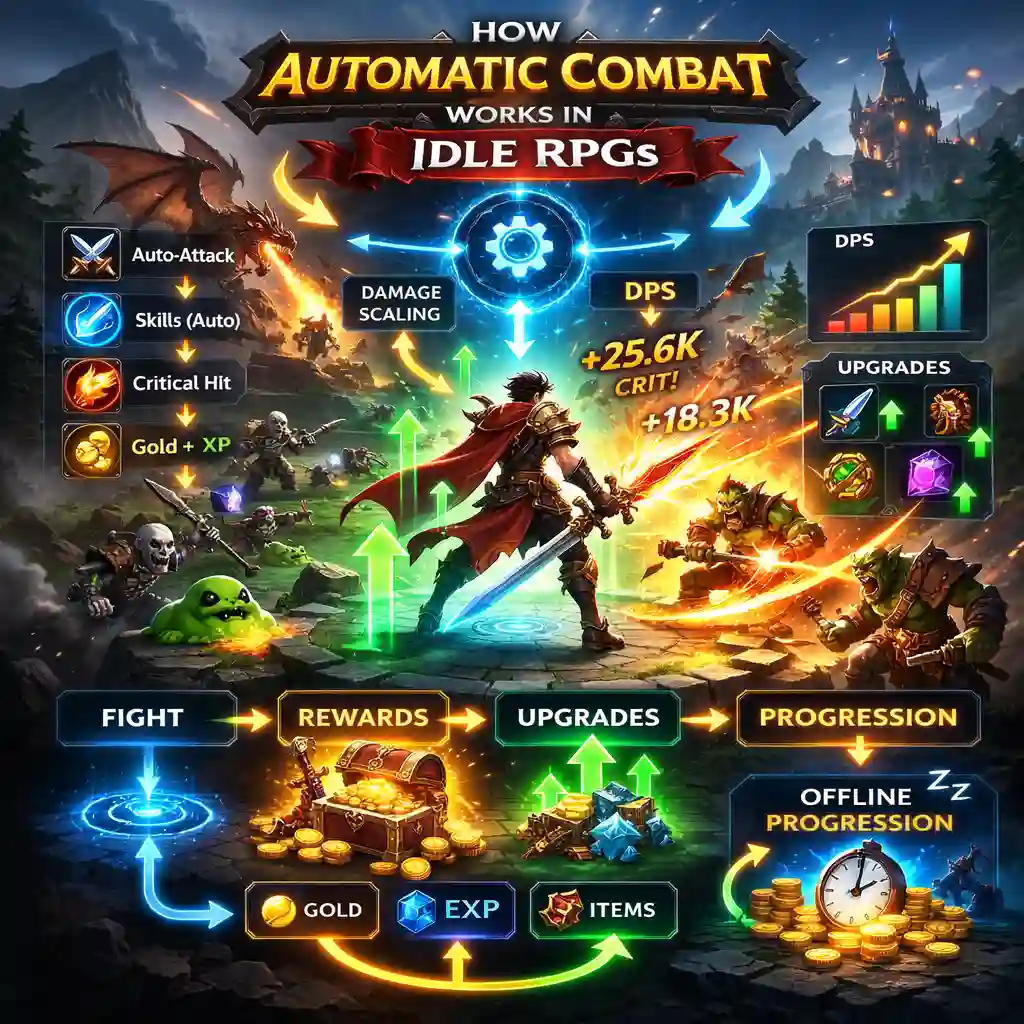
How Automatic Combat Works in Idle RPGs
Learn how automatic combat works in idle RPGs, including DPS formulas, damage scaling, offline progression systems, and strategic optimization that replaces manual control with long-term growth mechanics.
Automatic combat in idle RPGs is a system where characters fight enemies on their own without constant player input. Instead of manually controlling attacks, players focus on optimizing stats, upgrades, and scaling systems that increase overall damage output and survivability. This automation shifts gameplay from mechanical execution to strategic progression management.
What Is Automatic Combat in Idle RPGs?
Automatic combat is a battle system where the game engine handles attacking, targeting, and skill activation automatically. Players do not need to tap skills every second or manually move characters. The core loop revolves around:
-
Increasing damage output
-
Improving attack speed
-
Boosting survivability
-
Unlocking stronger automation layers
In most idle RPGs, combat continues even when the player is offline. This creates a long-term progression model where power growth matters more than reflexes.
How the Core Automatic Battle Loop Works
At its foundation, automatic combat follows a simple but scalable structure:
-
Character auto-attacks enemy
-
Enemy HP decreases
-
Enemy dies
-
Gold/XP/resources are rewarded
-
New enemy spawns
-
Cycle repeats
This loop seems basic, but scaling mechanics transform it into a complex optimization system.
Behind the scenes, most idle RPGs calculate damage based on formulas like:
Damage = Base Attack × Multipliers × Critical Modifiers
Automation replaces manual skill timing with statistical dominance. If your DPS is high enough, the loop accelerates. If not, progression stalls.
Why Automation Replaces Manual Control
In traditional RPGs, skill expression comes from timing, positioning, and reaction speed. Idle RPGs shift that expression into system optimization.
Instead of asking:
“Can you dodge and combo properly?”
Idle RPGs ask:
“Can you optimize multipliers and scaling efficiently?”
Automation enables:
-
Long session gameplay without burnout
-
Background farming
-
Strategic upgrade planning
-
Exponential scaling systems
This design choice supports the genre’s long-term retention structure.
If you are still exploring the broader genre structure, read our complete pillar explanation: What Is an Idle RPG? Complete Beginner Explanation. That article breaks down how automation fits into the full idle RPG framework.
Damage Calculation in Automatic Combat
Even though battles run automatically, the math behind them is structured and deliberate.
Base Damage
Every character starts with a base attack stat. This number increases through leveling, equipment, and upgrades.
Attack Speed
Automatic systems often calculate DPS as:
DPS = Damage per Hit × Attacks per Second
Improving attack speed can be just as impactful as increasing raw damage.
Critical Chance and Critical Damage
Many idle RPGs include critical hit systems. When triggered, damage is multiplied by a critical modifier.
Example:
If Crit Damage = 200%, a successful critical hit deals double damage.
In automatic combat, critical chance becomes a probability-based multiplier applied continuously over time.
Skill Automation
Advanced idle RPGs introduce auto-casting skills. These may trigger:
-
On cooldown
-
On enemy death
-
On damage thresholds
-
Passively as aura effects
Instead of manual activation, optimization revolves around synergy and timing efficiency.
Offline Progression and Background Combat
One defining trait of automatic combat in idle RPGs is offline progression.
When a player closes the game:
-
Combat simulation continues
-
Resources accumulate
-
Time-based multipliers apply
Some games simulate exact DPS over time. Others use approximated formulas to calculate offline rewards.
Offline combat systems rely heavily on:
-
Average DPS
-
Clear speed
-
Stage progression
-
Survival thresholds
This reinforces why damage optimization becomes central to progression.
Automation Layers and Scaling Depth
As players progress, automation often becomes deeper and more complex.
Early Game:
-
Basic auto-attacks
-
Simple stat upgrades
Mid Game:
-
Auto skill triggers
-
Companion or pet automation
-
Area-based farming
Late Game:
-
Full team automation
-
AI behavior priorities
-
Conditional combat logic
-
Prestige-enhanced auto scaling
Automatic combat evolves from simple background fighting into a fully optimized damage engine.
Common Design Variations in Automatic Combat
Not all idle RPGs structure automation identically.
Wave-Based Combat
Enemies spawn in waves. Progression depends on clearing waves within time limits.
Boss-Gated Progression
Bosses act as damage checks. If DPS is insufficient, players must upgrade before advancing.
Endless Scaling Modes
Some idle RPGs introduce infinite stages where enemy HP scales exponentially.
Hybrid Manual + Auto Systems
Certain games allow manual skill activation for bursts while keeping base combat automated. This creates partial interactivity without abandoning idle design principles.
Why Automatic Combat Feels Rewarding
Despite minimal manual input, automatic combat remains satisfying because:
-
Numbers visibly increase
-
Clear speed accelerates
-
Milestones unlock new systems
-
Multipliers compound over time
Watching damage climb from thousands to millions to billions creates a tangible sense of growth.
The reward comes from strategic decisions rather than mechanical skill.
Strategic Optimization in Automatic Systems
Winning in idle RPG automatic combat is not about tapping faster. It is about:
-
Prioritizing multiplicative upgrades
-
Balancing survivability vs damage
-
Timing prestige resets
-
Managing resource allocation
Automation shifts the core question from “How fast can you react?” to “How efficiently can you scale?”
Automatic Combat as the Foundation of Idle RPG Design
Automatic combat is not just a convenience feature. It is the structural backbone of the idle RPG genre.
Without automation:
-
Offline progression would collapse
-
Exponential scaling would feel tedious
-
Long-term loops would break
Automation allows systems like DPS scaling, multiplier stacking, and prestige loops to function cohesively.
If you want a broader understanding of how these systems connect together, revisit our main guide: What Is an Idle RPG? Complete Beginner Explanation. It explains how automatic combat integrates with DPS, multipliers, and long-term progression loops.
Conclusion
Automatic combat in idle RPGs transforms battle from mechanical execution into statistical optimization. Instead of controlling every swing or spell, players focus on building systems that fight efficiently on their behalf.
By understanding how automatic battle loops, DPS formulas, scaling systems, and offline simulation work together, players can optimize progression and avoid common scaling mistakes.
In idle RPGs, the strongest player is not the fastest clicker. It is the best system optimizer.