Core Mechanics in Incremental Games
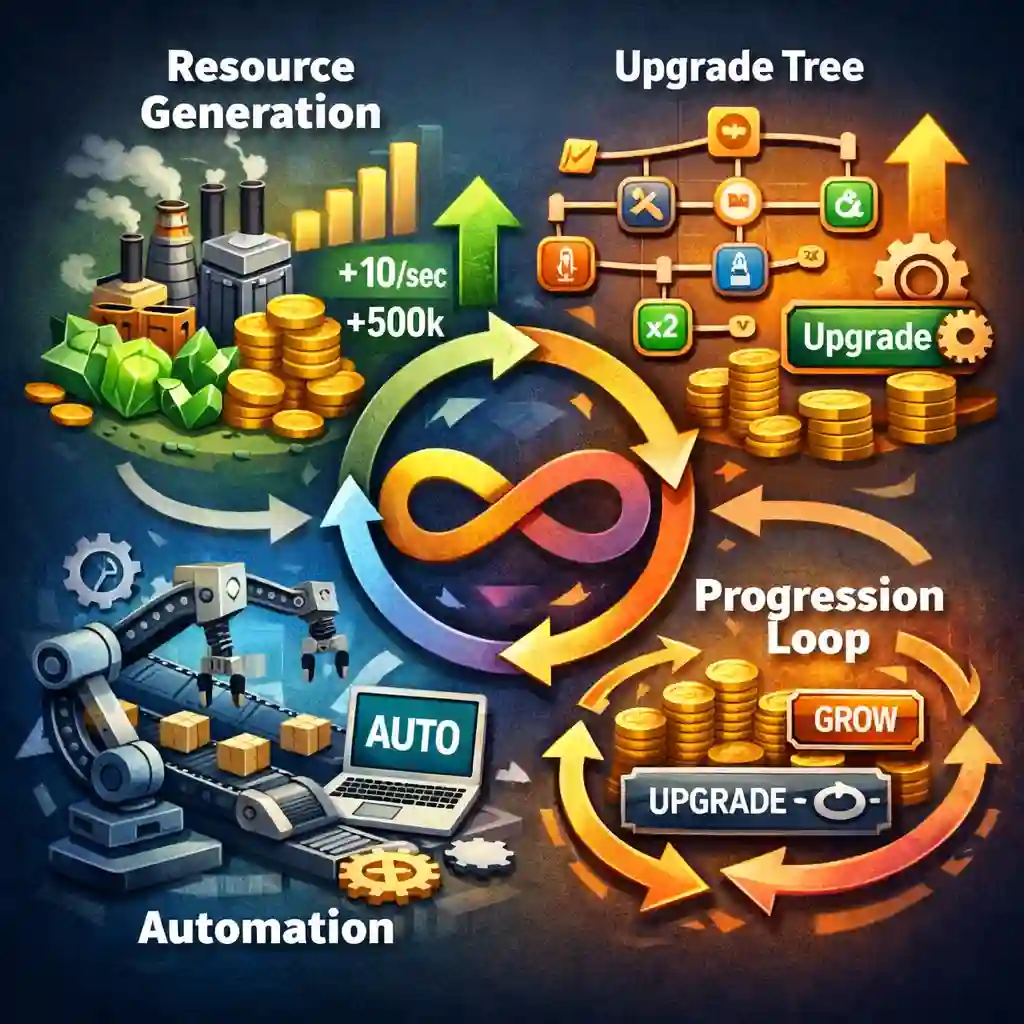
Core mechanics in incremental games include resource generation, upgrade trees, automation systems, and progression loops that drive long-term growth and player engagement.
Core mechanics in incremental games refer to the fundamental systems that drive player progression through continuous resource generation, upgrades, automation, and expanding progression loops. These mechanics form the foundation of the incremental genre by allowing numbers, production rates, and systems to grow over time while maintaining long-term engagement through strategic optimization and layered progression.
Understanding Core Mechanics in Incremental Games
Incremental games may appear simple at first, often beginning with a single action such as clicking to generate a resource. However, beneath this simple interaction lies a complex structure of interconnected systems designed to create continuous progression. The core mechanics in incremental games determine how players generate resources, unlock upgrades, automate production, and expand their progression over time.
At the center of these systems is the concept of gradual growth. Instead of fast-paced action or traditional levels, incremental games rely on steadily increasing numbers that represent progress. Every improvement, whether through upgrades, automation, or scaling systems, pushes the player toward larger milestones.
To understand how these systems work together, it is helpful to first explore the broader structure of the genre. Our main guide, What Is an Incremental Game? Complete Guide to Incremental Games, Mechanics, and Progression Systems, explains how these mechanics combine to create the long-term progression loops that define incremental gameplay.
Resource Generation Systems in Incremental Games
Resource generation is the most fundamental mechanic in incremental games. It determines how players produce the numbers that drive progression.
Most incremental games begin with a simple resource generator. Players might click a button to earn currency, produce materials, or generate points. While this initial mechanic seems basic, it serves as the starting point for the entire progression system.
Over time, games introduce additional generators that increase production speed or output. These generators may include buildings, workers, factories, or automated units that produce resources continuously.
Resource generation systems usually evolve through several stages:
• Manual generation – players actively click or interact to produce resources.• Semi-automated generation – upgrades begin producing resources automatically.• Fully automated production – generators run continuously without player input.• Exponential scaling – production increases dramatically through multipliers and upgrades.
The design challenge for developers is ensuring that resource production grows at a satisfying pace without becoming too slow or excessively fast. This balance keeps players engaged while allowing the numbers to expand into extremely large values.
Upgrade Trees in Incremental Games
Upgrades are the primary way players improve efficiency and expand production capabilities. In many incremental games, upgrades are structured as upgrade trees that provide branching paths of progression.
Upgrade trees allow players to make strategic decisions about how to allocate resources. Instead of unlocking improvements in a linear sequence, players can choose between different upgrades that affect gameplay in various ways.
Common upgrade types include:
• Production multipliers that increase resource output.• Speed upgrades that reduce production time.• Automation upgrades that unlock passive generation.• Unlock upgrades that reveal new mechanics or generators.
These upgrades often become more expensive as the game progresses, encouraging players to carefully consider which upgrades provide the greatest efficiency boost.
Well-designed upgrade trees create meaningful choices while guiding players toward new layers of gameplay. As upgrades accumulate, the player's production system becomes increasingly powerful and complex.
Automation Systems in Incremental Games
Automation is one of the defining features of the incremental genre. While many games begin with manual actions such as clicking, they gradually introduce systems that automate production.
Automation systems transform incremental games from active clicking experiences into long-term idle ecosystems.
Examples of automation mechanics include:
• Auto-clickers that replicate manual actions• Passive generators that produce resources continuously• Worker systems that perform tasks automatically• Offline progress that generates resources while the player is away
Automation allows players to focus less on repetitive actions and more on strategic optimization. Instead of manually producing resources, players begin managing complex production systems and deciding how to expand them.
This shift from manual interaction to automated systems is what gives incremental games their long-term appeal. Players transition from clicking for resources to designing entire production networks that grow independently.
Progression Loops in Incremental Games
Progression loops represent the repeating cycle that drives long-term engagement in incremental games.
A typical progression loop follows a pattern:
Each loop allows players to reach higher milestones and unlock more advanced mechanics. Over time, these loops expand into layered progression systems that include new generators, automation features, scaling multipliers, and sometimes prestige resets.
The key to a successful progression loop is momentum. Players must feel that every upgrade brings them closer to the next breakthrough, whether it is a new feature, a production milestone, or a major system unlock.
This constant cycle of improvement creates the addictive growth pattern that defines incremental gameplay.
How Core Mechanics Work Together
While each system plays a different role, the real strength of incremental game design comes from how these mechanics interact.
Resource generation produces the numbers that fuel progression. Upgrade trees improve efficiency and unlock new gameplay layers. Automation systems reduce repetitive actions while expanding production. Progression loops ensure that players always have a new milestone to pursue.
When these mechanics are balanced correctly, they create a gameplay experience built around continuous growth. The player moves from small, manual actions to large-scale automated systems that produce enormous numbers over time.
This layered design is why incremental games can remain engaging for days, weeks, or even months. Every new upgrade or system expands the possibilities of the game while reinforcing the central progression loop.
Why Core Mechanics Define the Incremental Genre
Core mechanics are what separate incremental games from other genres. While many games include upgrades or progression systems, incremental games revolve entirely around systems that generate and scale numbers over time.
The focus on gradual growth, automation, and long-term progression creates a unique gameplay experience that differs from traditional action or strategy games.
Players are not simply completing levels or defeating enemies. Instead, they are building systems that continuously expand, optimizing production chains, and unlocking new mechanics that push the game toward increasingly larger milestones.
Because of this design philosophy, incremental games often become deeply engaging experiences where progression never truly stops.
Final Thoughts on Core Mechanics in Incremental Games
Understanding the core mechanics in incremental games helps players appreciate the systems that drive long-term progression in the genre. Resource generation, upgrade trees, automation systems, and progression loops all work together to create the continuous growth that defines incremental gameplay.
These mechanics transform simple interactions into complex ecosystems where players build and optimize production systems over time. The result is a genre built entirely around expansion, efficiency, and the satisfaction of watching numbers grow.
As incremental games continue to evolve, developers keep experimenting with new mechanics, deeper progression layers, and more advanced automation systems. But at the heart of every successful incremental game, these core mechanics remain the foundation that keeps players engaged.