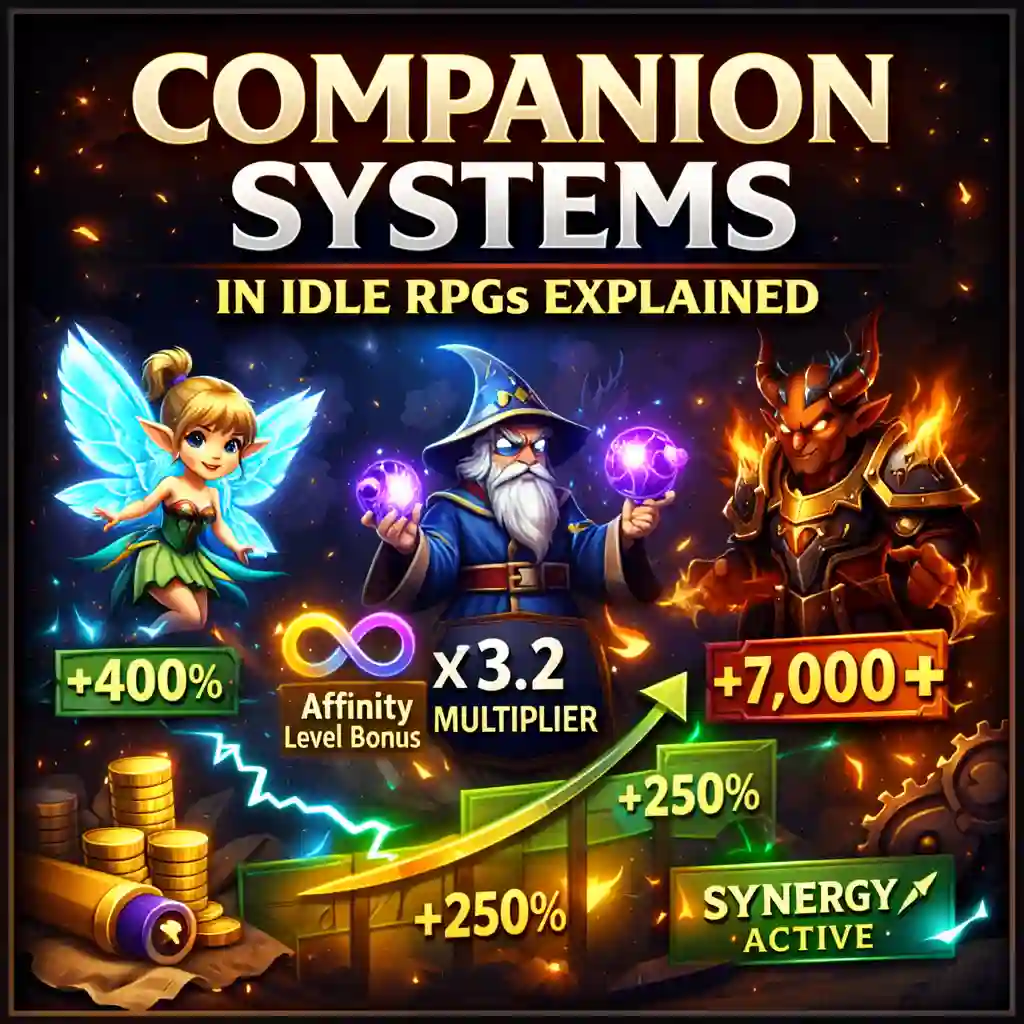
Companion Systems in Idle RPGs Explained
Companion systems in idle RPGs introduce affinity mechanics, synergy stacking, and multiplicative scaling that transform simple stat boosts into powerful progression engines driving mid-game optimization and late-game exponential growth.
Companion systems in idle RPGs are progression mechanics that provide multipliers, affinity scaling, and synergy bonuses that significantly impact overall performance. Far from cosmetic additions, companions function as core amplifiers that influence mid-game optimization, late-game scaling, and long-term strategic depth.
Introduction: Companions Are Not Just Visual Additions
In early idle RPG design, companions often existed as simple thematic additions. Modern idle RPGs, however, treat companions sometimes called fairies, heroes, spirits, or allies as structural progression layers.
If you are new to the genre and want a broader overview before diving into advanced systems like companions, you may find it helpful to first read What Is an Idle RPG? Complete Beginner Explanation, which outlines the foundational mechanics of idle progression.
Once those basics are understood, companion systems reveal their true strategic importance.
What Defines a Companion System?
A companion system typically includes:
Unlike base stat upgrades, companions often scale independently. This independence allows them to act as parallel growth engines rather than simple additive bonuses.
In many modern idle RPGs, companions become the primary driver of exponential growth during mid-to-late progression phases.
Affinity Mechanics: The Hidden Growth Curve
Affinity systems add a relational progression layer between the player and companion.
Affinity may increase through:
The impact of affinity is often subtle at first. For example:
However, when affinity caps reach hundreds or thousands of levels, the compounded effect becomes massive.
Affinity systems introduce long-term investment decisions. Players must decide:
This transforms companions from passive bonuses into strategic assets.
Synergy Stacking and Cross-Companion Interaction
Modern idle RPGs rarely design companions as isolated units. Instead, they encourage synergy stacking.
Examples of synergy systems include:
This creates interaction layers.
Instead of asking which companion gives the highest raw multiplier, players analyze combinations. The value of a companion becomes dependent on the broader system context.
Synergy stacking increases build diversity and prevents linear optimization paths.
Scaling Impact in Mid-Game Progression
Companion systems typically become essential during mid-game.
Early progression often relies on base upgrades and simple stat scaling. As costs rise and diminishing returns appear, companion scaling provides alternative growth vectors.
At this stage, players experience:
Companions offer new multipliers that bypass some of these bottlenecks.
Mid-game optimization frequently revolves around:
The shift from base scaling to layered scaling is what defines modern idle RPG complexity.
Late-Game Companion Dominance
In late-game environments, companion systems often surpass base stats in importance.
Reasons include:
Late-game idle RPG design frequently balances content around optimized companion usage. Players who neglect companion development may experience stagnation despite high base stats.
At this stage, companions act as meta-defining systems rather than supplementary mechanics.
Retention Through Personal Investment
Companion systems are powerful retention tools.
They create:
Affinity progression in particular encourages sustained engagement. Even small incremental gains create visible long-term payoff.
By combining mechanical value with progression identity, companion systems extend player lifetime significantly.
Design Perspective: Why Companion Systems Matter
From a design standpoint, companion systems serve multiple functions:
Modern idle RPG design increasingly centers around such layered systems rather than simple numerical scaling.
Companions are not optional enhancements. They are structural components of strategic depth.
Conclusion
Companion systems in idle RPGs represent a major evolution in genre design. Through affinity mechanics, synergy stacking, and multiplicative scaling, companions transform idle gameplay into a layered optimization experience.
What appears to be a simple supporting feature often becomes a central progression engine.
Understanding companion mechanics is essential for mastering mid-to-late game scaling and maximizing long-term efficiency in modern idle RPG systems.