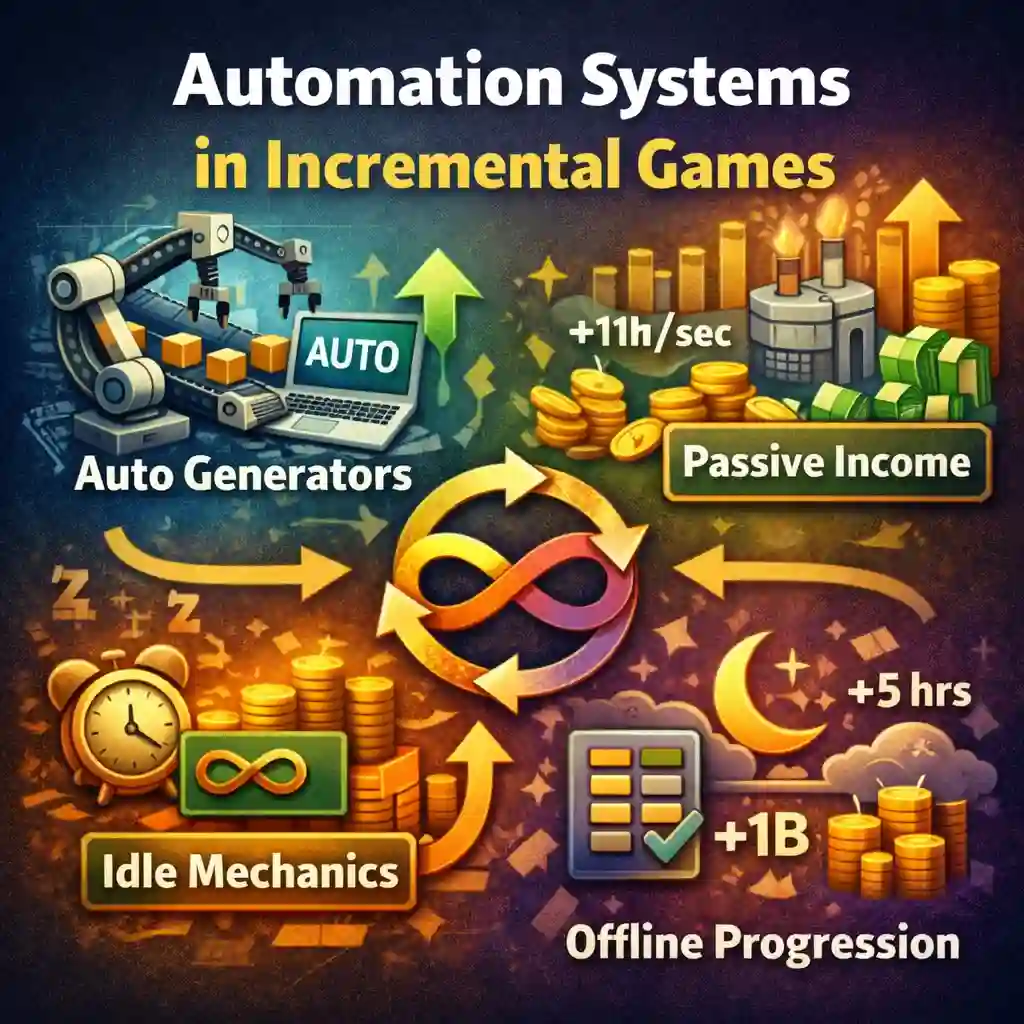
Automation Systems in Incremental Games
Automation systems in incremental games include auto-generators, passive income, idle mechanics, and offline progression that allow resources to grow automatically and support long-term gameplay progression.
Automation systems in incremental games are mechanics that allow resource production to continue without constant player interaction. These systems include auto-generators, passive income mechanics, and offline progression, all designed to transform simple manual gameplay into scalable idle ecosystems that support long-term progression.
Understanding Automation in Incremental Games
Automation is one of the most important mechanics that define the incremental game genre. While many incremental games begin with manual actions such as clicking or tapping to generate resources, they gradually introduce systems that automate production.
This transition from manual gameplay to automated systems is a key part of the genre’s design philosophy. Instead of repeating the same action indefinitely, players unlock systems that perform these tasks automatically. As automation increases, the player’s role shifts from active interaction to strategic optimization.
To better understand how automation fits into the overall structure of the genre, it helps to explore the broader mechanics that define incremental games. Our main guide, What Is an Incremental Game? Complete Guide to Incremental Games, Mechanics, and Progression Systems, explains how automation systems work alongside resource generation, upgrades, and scaling mechanics to create long-term gameplay loops.
Automation mechanics are what allow incremental games to grow into complex systems where production continues even when the player is not actively interacting with the game.
Auto Generators in Incremental Games
Auto-generators are systems that produce resources automatically without requiring manual input from the player. They are often one of the first automation mechanics introduced in incremental games.
At the start of many incremental games, players must manually click or perform actions to earn resources. Once auto-generators become available, these actions begin happening automatically at regular intervals.
Examples of auto-generators include:
• Factories that produce currency over time• Workers that gather resources automatically• Machines that generate materials every second• Buildings that create passive production chains
Auto-generators significantly increase production efficiency. Instead of generating resources one click at a time, players begin managing systems that produce resources continuously.
As more generators are unlocked, players can scale their production systems to generate increasingly larger numbers. This transition marks the point where an incremental game begins to feel more like a fully automated economy.
Passive Income Systems in Incremental Games
Passive income systems allow players to earn resources without actively performing actions in the game. These systems are closely related to automation but often focus on long-term resource generation rather than individual production units.
Passive income may come from various sources within an incremental game, including:
• Automated generators producing resources every second• Global bonuses that increase resource production• Investment-style mechanics that generate currency over time• Background production systems linked to upgrades
Passive income is essential for maintaining the pacing of incremental games. Since many upgrades become increasingly expensive, players rely on passive systems to accumulate resources gradually while planning their next upgrade or milestone.
These systems also encourage players to return to the game periodically to collect resources, unlock new upgrades, or expand their production networks.
Idle Systems and Automated Gameplay
Idle systems are mechanics that allow incremental games to continue progressing even when the player is not actively interacting with the game.
Once automation and passive income systems are fully established, players often reach a stage where the game continues generating resources entirely on its own. This creates an idle gameplay experience where players occasionally return to optimize their systems or unlock new upgrades.
Idle gameplay changes the role of the player. Instead of focusing on manual actions, players begin making higher-level decisions such as:
• Which upgrades provide the best efficiency• How to balance different generators• When to trigger prestige or reset mechanics• How to optimize long-term resource growth
This strategic layer is what keeps incremental games engaging over long periods of time.
Offline Progression in Idle and Incremental Games
Offline progression allows players to earn resources even when the game is closed. This mechanic is particularly common in mobile idle games but is also used in browser and PC incremental games.
When players return to the game after being away, they typically receive a summary showing how many resources were generated during their absence. This feature makes the game feel constantly active and rewards players for returning regularly.
Offline progression systems usually work in several ways:
• Simulating production during offline time• Calculating a percentage of normal production while away• Granting capped offline rewards to maintain balance• Providing bonuses for extended idle periods
These systems help maintain momentum in the progression loop. Even when players are not actively playing, their production systems continue expanding.
The Role of Automation in Long-Term Gameplay
Automation systems play a crucial role in maintaining the long-term engagement of incremental games. Without automation, gameplay would eventually become repetitive and exhausting due to constant manual interaction.
By gradually introducing automated systems, developers allow players to shift their focus from repetitive tasks to strategic decision-making.
Players begin optimizing their production systems, unlocking more efficient generators, and experimenting with upgrade combinations that maximize resource growth.
This transformation—from manual gameplay to automated production networks—is one of the most satisfying aspects of the incremental genre.
How Automation Supports Incremental Game Design
Automation mechanics are not simply convenience features; they are essential design components that enable the genre to function at scale.
As numbers grow larger and systems become more complex, manual interaction alone would not be practical. Automation allows the game to expand into larger economic systems where production continues independently.
Well-designed automation systems provide a sense of progress while maintaining player agency. Players still make important decisions about upgrades, production priorities, and progression strategies.
This balance between automated production and player control is what makes incremental games both relaxing and engaging.
Final Thoughts on Automation Systems in Incremental Games
Automation systems are one of the defining mechanics of incremental games. Through auto-generators, passive income systems, idle gameplay, and offline progression, these mechanics allow games to scale far beyond simple clicking mechanics.
As players unlock automation features, the gameplay experience evolves from manual interaction into a sophisticated system of automated production and strategic optimization.
This transition is what allows incremental games to maintain long-term engagement while supporting massive number growth and complex progression systems.
By combining automation with upgrades, scaling mechanics, and milestone systems, incremental games create a gameplay loop where progress continues even when the player is not actively playing.