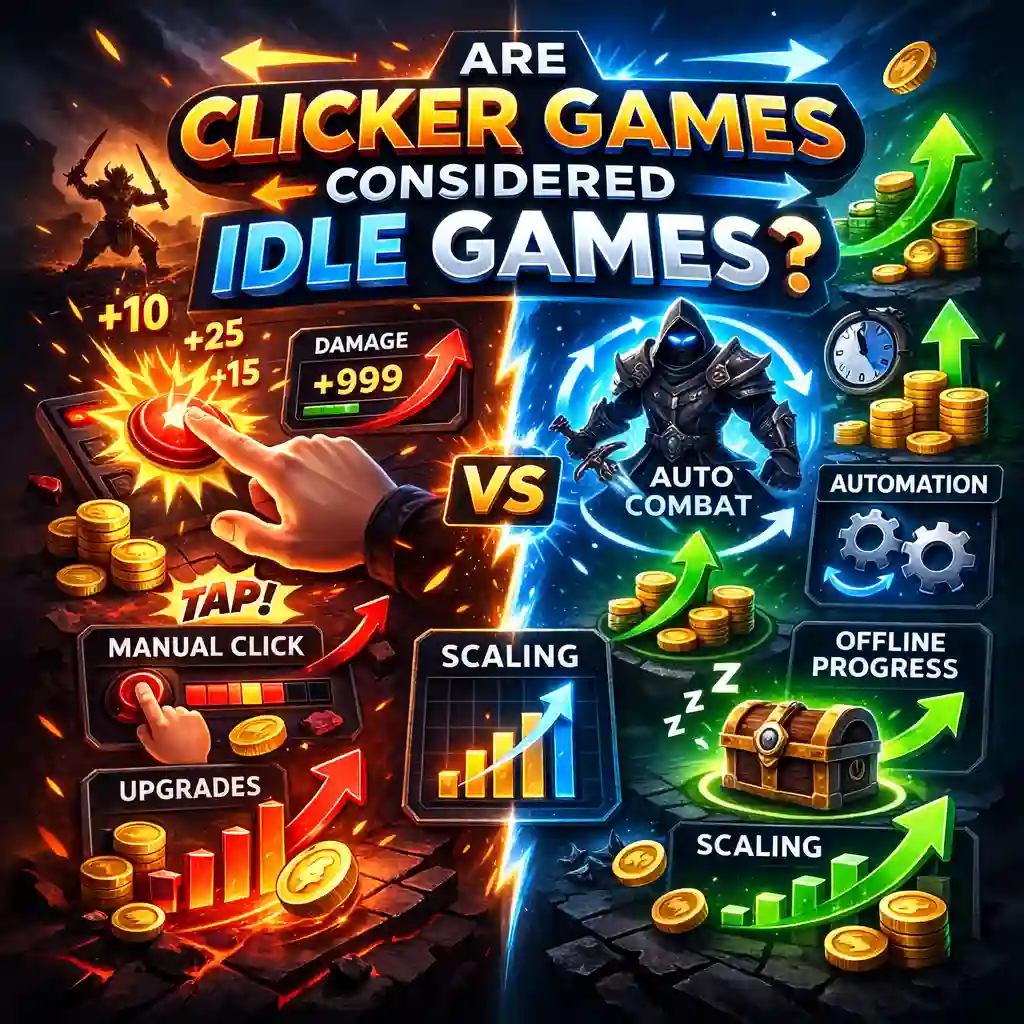
Are Clicker Games Considered Idle Games?
Are clicker games considered idle games? Learn the real difference between clicker and idle genres, including automation depth, scaling systems, and progression mechanics explained clearly.
Clicker games and idle games are often grouped together, but they are not always the same genre. While both rely on incremental progression, automation, and exponential scaling systems, the core difference lies in how player interaction drives advancement. This guide explains whether clicker games truly qualify as idle games and how genre classification works in modern game design.
Why This Genre Debate Exists
The confusion comes from shared mechanics.
Both clicker games and idle games feature:
Because of these similarities, many players use the terms interchangeably. However, from a design perspective, the distinction depends on how central automation is to progression.
To understand the broader foundation of idle systems before diving into classification debates, you may want to read What Is an Idle RPG? Complete Beginner Explanation, which outlines how automation and layered progression define true idle design.
What Defines an Idle Game?
An idle game is primarily defined by automated progression.
Core characteristics typically include:
In a pure idle design, the player’s role is strategic rather than mechanical. The game continues running efficiently even when the player is not actively interacting.
Automation is not optional in idle games it is the foundation.
What Defines a Clicker Game?
Clicker games are built around manual interaction as the starting driver of progression.
Common features include:
In most clicker games, the early and mid-game phases heavily depend on player input. Automation exists, but it supplements manual clicking rather than replacing it entirely.
The Core Classification Question
So, are clicker games considered idle games?
The answer depends on how much automation replaces manual input.
There are three main classification perspectives:
1. Broad Classification View
Under a broad genre definition, clicker games are a subcategory of idle games.
Reason:Both rely on incremental progression, scaling multipliers, and prestige systems.
In this perspective, “idle” becomes an umbrella term that includes clickers, incremental games, and automation-heavy RPG hybrids.
2. Strict Design Perspective
Under stricter design analysis, clicker games are not fully idle unless automation becomes dominant.
If the optimal strategy requires constant clicking, the game leans more toward clicker than idle.
Idle design requires:
In this view, many clicker games are transitional hybrids rather than true idle systems.
3. Evolution-Based Perspective
Some designers argue that clicker games represent the evolutionary starting point of idle games.
Early clicker titles emphasized manual tapping. Over time, automation systems grew more sophisticated, eventually creating modern idle genres such as:
From this angle, clickers are historically linked to idle games but not identical in design philosophy.
Automation as the Deciding Factor
The clearest dividing line between clicker and idle classification is automation depth.
In clicker-focused design:
In idle-focused design:
If a game can progress efficiently without continuous tapping, it qualifies more strongly as idle.
If it demands ongoing clicking to remain optimal, it leans toward clicker.
Scaling Systems and Prestige Mechanics
Both genres use exponential scaling and reset systems.
However, their implementation differs.
Clicker scaling:
Idle scaling:
While both rely on incremental growth curves, idle systems often integrate deeper progression layers beyond raw clicking power.
Why Modern Games Blur the Line
Many modern games combine elements of both genres.
Hybrid designs include:
Because of this blending, genre labels become flexible rather than rigid categories.
Players often categorize games based on feel rather than technical structure.
Practical Classification Rule
A simple way to classify a game:
If removing clicking would break the game’s progression speed → It’s primarily a clicker.If removing clicking would barely affect optimal long-term growth → It’s primarily idle.
This practical rule helps distinguish interaction-driven design from automation-driven design.
Final Verdict
Are clicker games considered idle games?
In broad usage, yes they are often grouped together.
In strict design terms, not always.
Clicker games emphasize manual interaction, while idle games prioritize automation and strategic optimization. The classification depends on which system drives progression most strongly.
Understanding this difference clarifies why some players treat the terms as interchangeable, while others separate them based on system depth and automation dominance.
Ultimately, the label matters less than the design philosophy behind the mechanics and recognizing that philosophy helps players choose the experience that fits their preferred style of progression.